Monday, July 21, 2014

Nunnery vs. Convent

The Chi Lin Nunnery at Diamond Hill, Kowloon
What is the difference between a Nunnery and a Convent?  Until recently, I didn't know the former was even a word.  A colleague at work suggested that we visit Chi Lin Nunnery in the Diamond Hill area of Kowloon, and since the recent warnings for Typhoon Rammasun had been cancelled, we decided to take her advice.
The Main Hall of the Chi Lin Nunnery is constructed
from timber without the use of a single nail
The Chi Lin Nunnery is a large monastic complex founded in the 1930s as a retreat for Buddhist nuns.  Surrounded by high rise apartment buildings, the Nunnery and the adjacent Nan Lian Garden are a green and peaceful oasis occupying about sixteen acres in North Kowloon.


The first of two courtyards leads to the Hall of Celestial Kings

A fountain in the one of the lotus ponds
The Nunnery underwent a substantial renovation that was finished in 2000, with the buildings constructed in the architectural style of the Tang dynasty (618-907 AD).  The Main Hall was constructed by traditional craftsmen from Arnhui Province in China using timber held together with only wooden brackets, making it the largest handcrafted building in the world.  The roof makes this fact even more impressive because its 28,000 clay tiles weigh in at 176 tons.  The complex is arranged around three courtyards, only two of which are open to the public.  The first courtyard contains landscaped Lotus Gardens with four large lotus ponds, surrounded by bonsai trees.  At the top of the first courtyard is the Hall of Celestial Kings which leads into the second courtyard. This courtyard is surrounded by covered walkways linking four more halls to the Main Hall.  Each of these halls feature statues of Buddhas and Bodhisattvas at alters where offerings of fruit are placed and the faithful actively worship.

One of the four lotus ponds
The Nunnery is home to about 60 nuns, and under an agreement with the Hong Kong Government, the Chi Lin Nunnery maintains and manages the Nan Lian Garden for a nominal fee of HK$1.00.  The garden, which was also built in the Tang style, opened in 2006 and was designed to minimize its urban surroundings through the use of barriers and tree plantings to filter noise, exhaust and dust. 

The Perfection Pavilion and Zi Wu Bridge are among
the timber structures in the Nan Lian Garden
Tang style gardens feature four elements to include ornamental rocks or hillocks, water features, old trees and timber structures.   These elements come to life in the Nan Lian Garden through the use of rocks from a variety of sources in China, a large waterfall and Koi pond, a number of sweet-scented trees including osmanthus, lily and orange-jasmine and the Perfection Pavilion, the Zi Wu Bridge and other structures.  There is even a vegetarian restaurant tucked behind the waterfall so that diners can look through the torrent falling from above them while eating lunch.

A large Koi Pond is one of the water elements in the Tang style garden

Diners at the vegetarian restaurant sit behind a waterfall
In Hong Kong it is easy to get caught up in hectic pace of life.  Our trip to Chi Lin Nunnery and the Nan Lian Garden was a good reminder that there are tranquil oases nearby and it's just a matter of knowing where to find them.  And for those who are still wondering, there are many opinions about the difference between a Nunnery and a Convent.  With very little effort, I found a number of references.  They range from those that indicate there is no difference at all, to others that describe a Nunnery as the place where nuns reside and a Convent as a religious community with rules and vows by which the residents live.

The Nan Lian Garden is a tranquil retreat from its urban surroundings

Tuesday, July 15, 2014

These Are a Few Of My Favorite Hong Kong Things

 
Rebecca enjoys dim sum upon arrival in Hong Kong
This is a "guest blog" written by my niece Rebecca McCray.  Rebecca just wrapped up a nine-month stint as a Fulbright Scholar studying and writing about the Slovenian penal system.  We enticed her to "take the long way home" with a week-long stopover in Hong Kong on her way back to New York.  After nearly six months in Hong Kong, we were thrilled to have a visit from family.  Our week together went by too quickly, but was filled with fun and adventure, and Rebecca graciously agreed to share her experiences.


In early July, I was lucky enough to visit Carolyn and Jeff in Hong Kong on my way back to the U.S. from Slovenia, where I lived for nine months. A first-time visitor, I didn’t know what to expect, but I knew that they would show me a great time. I left daydreaming about when I could come back and with an even deeper appreciation for dim sum.


Waiting for egg tarts at Tai Cheong Bakery
 
1. Food
 
If you know me at all, you know that I love to eat. If you know me a little better, you know that I love to eat dumplings. In other words, Hong Kong was a dream come true. Less than four hours after I arrived from Slovenia, Carolyn and I lined up outside of
Tim Ho Wan, a Michelin-starred dim sum chain, scrawling our order on a piece of paper before sitting down to devour the best BBQ pork buns that have ever graced my mouth. This meal set the tone for the gastronomic bliss that was the rest of the week. From traditional egg tarts and chicken pies at Tai Cheong Bakery, to Indian food and dumplings at the cooked food market, to afternoon tea at Café Grey, to ramen at Ippudo, it was all fantastic. I didn’t have a bad meal in Hong Kong, thanks in large part to my fabulous hosts. 


 2. Beautiful Views

While Carolyn went to work in the morning, I attempted to work at her apartment until we met up in the afternoon. Most days I was only moderately successful, in large part because I was so distracted by the fantastic view into the city from Jeff’s office. Thanks to the steep hills of Hong Kong, Carolyn and Jeff’s apartment in the Mid-Levels dizzyingly peers down into the many buildings, harbour, and bay. On a clear day (of which I was lucky to have many), you can easily see the gorgeous mountains that surround the city, which makes the view all the more stunning. The staggered construction of incredibly tall, narrow, and tightly packed buildings down the slope of Hong Kong makes for a truly surreal sight. For an even more picturesque look at the city, we rode a Green Mini Bus up to Victoria Peak for a nice walk amidst the greenery and a look at the bizarre Peak Tower, which looks down over the city. And perhaps the most breathtaking view came from our cable-car adventure to the Tian Tan Buddha.

Taking in the view from the Peak Circle Walk
 
3. Public Transportation
 
To my confusion and delight, Carolyn 
A selfie in the back of a Green Mini-Bus
handed me a card that read “Octopus” when she met me at the airport. I was happy to take it just because of its name, but it was also my ticket to nearly every kind of public transportation the city offers. Double-decker trams, double-decker buses, green mini-buses, and the MTR all accept the Octopus card. Only the mysterious red mini bus doesn't take Octopus. Between living in New York City and traveling around Europe this past year, I’ve come to really appreciate good public transportation (and the challenge of navigating it in new places). Hong Kong was so much fun in this department. Though to be honest, I didn’t have to navigate anything thanks to my fearless leader. I think the quirky double-decker tram was my favorite, with the green mini bus coming in at a close second. You have to respect a tiny bus that will only stop if you yell at the driver, don’t you?


4. Markets

Hong Kong’s myriad outdoor and indoor market offerings run the gamut from tacky plastic souvenirs to unidentifiable dried sea creatures to delicious hot food. The cooked food market was probably my favorite. Also called cooked food centres, these indoor markets tucked into massive buildings house food vendors who used to operate dai pai dongs, which are unlicensed street food stalls. A few remain in Hong Kong, but most have been chased inside to these cooked food markets thanks to the government’s licensing requirements. From what I understand, some harbor nostalgia for the outdoor stalls, but given Hong Kong’s sauna-like heat in July, I didn’t mind going inside to explore the cooked food options. We weren’t able to visit Carolyn’s favorite dumpling stand (where she recently accidentally bought 72 dumplings in an ordering mishap; I didn’t understand what the problem was), but I did try another dumpling stand and some insanely delicious Indian food, washed down with a fresh lime soda. The hodgepodge of tables and chairs, my lack of Cantonese, and generally feeling over-stimulated by the many options was pretty bewildering in the best possible way. I also enjoyed Stanley market, in large part because of the great bus ride we took over the top of the peak from the most densely populated part of Hong Kong. My one regret of the week is being too exhausted to make it to Hong Kong’s night market in “Little Thailand,” but now I have an excuse to go back.
 

Papier-mâché Pandas at PMQ

Climbing 268 steps to the Tian Tan Buddha


5. Mountains

As I already mentioned, the mountains make for an incredible backdrop when gazing out from the midst of the city. It’s incredible to see such lush, green, undeveloped masses of land surrounding the crazy concrete mass that is Hong Kong. While walking around the Peak with Carolyn, I was struck by the feeling that I had just been magically airlifted out of the city streets into the jungle. The contrast between the two is palpable. Our trip to the Tian Tan Buddha and Po Lin Monastery on Lantau Island offered some of the best mountain views. We traveled up from the Tung Chung MTR station in a cable car with a clear floor (not recommended if you’re afraid of heights), which gave us a good look at a hiking trail up the mountain for the slightly more adventurous Buddha visitors. I hope to try it out when I visit again—but not in the summer.
 
Views of Lantau Island and the South China Sea

Monday, June 23, 2014

A Global Gourmet Tour

There are many things about Hong Kong that are overwhelming and intimidating, but none more so than the prospect of eating.  Even the idea of trying to write a little blog post is difficult because I just don't know where to start.  But Jeff and I both love to eat.  I come from a family of foodies, and we love to cook.  So food is clearly a topic I just can't ignore.
A lunch special at Sushi Kuu

One of the first things we noticed about Hong Kong is the atmosphere.  Everything is very densely packed together - the people, the housing, the buildings, the traffic, the lights, the sounds and the smells - literally everything.  With that density comes the sense that everything is in your face, all the time.  I've used the term "sensory overload" before, but I've never been to a place where it is so applicable as Hong Kong. And when it comes to food, it's simply not possible to walk down the street here without encountering something to eat nearly every step of the way.  
Jeff digs in to a Chinese "hot pot" dinner

Dumplings at Queen St. Cooked Food Centre


People love to eat out in Hong Kong, so on nearly every street there are restaurants from every corner of the globe, and they are full nearly all day long.  There are also convenience stores (stocked primarily with food), supermarkets, green grocers, fish mongers, rotisseries, delis, bakeries and neighborhood streets that convert to an open market every day.
Shellfish at North Point wet market


One of my favorites - a "Housewife Cake"


In the time we've been here, some of our funniest - and most frustrating - moments have come in pursuit of a meal.   There is no shortage of advice about food either - both from the locals and our fellow expats.  In general, there is a lot of suspicion towards food sourced in mainland China.  The use of pesticides and other agricultural chemicals is apparently so heavy and widespread, people openly avoid buying food from the mainland, and restaurants promote non-PRC food sources in the meals they serve.  In the supermarkets, there are as many imported products as there are locally produced.  Meat and dairy products are imported from Australia, New Zealand, Europe and the U.S., while much of the produce is from the U.S. and Kenya.

Honey imported from New Zealand
Sticky rice steamed in a Lotus Leaf

 
We'd like to think we are the adventurous types and willing to try new and unusual things.  After all, we didn't come all the way to Hong Kong just to eat food we already know.  We've had some terrific meals and some that have tested my nerve.  There is so much to learn about food here, I suspect that we will have only scratched the surface by the time my work assignment here is complete.

The photos below are a sampling of restaurants that we've passed in our various walks.  We are truly enjoying a global gourmet tour right here in Hong Kong!


Monday, June 9, 2014

Hanoi: Hot, Humid, Hectic

The Hanoi Opera House
Growing up in the '60s and  '70s, I formed my impressions of Hanoi through the media coverage of the war and the fact that my Dad, a Marine Corps pilot, served for more than a year in Vietnam at the height of the war.  In other words, Hanoi was not necessarily high on the list of places I wanted to visit.  On the other hand, I find Vietnam's history in pre-war French Indochina intriguing, giving me a curiosity to learn more about the culture there.  Just 90 minutes by air from Hong Kong, Hanoi is an easy trip, so we decided to go for a visit.
Typical street congestion in Hanoi
Following the war, Vietnam spent a number of years as an international pariah before adopting reforms in the mid-'80s that would restore diplomatic relations with other countries and begin to stabilize its economy.  Those reforms have paid off and in recent years, Vietnam's economy has been one of the fastest growing in the world.  We saw creative, entrepreneurial energy springing up nearly everywhere on the back of an aging infrastructure built under Communist rule.  Following a Tchaikovsky performance by the Vietnam National Symphony Orchestra, we were greeted by a tropical downpour when we emerged from the Opera House.  Vendors suddenly appeared from nowhere selling rain ponchos to the audience eager to get home.  Hanoi is filled with westerners, and they are the targets for citizens looking to sell everything from rickshaw rides to t-shirts.  But we found nearly everyone that we came in contact with to be helpful, polite and kind.

The park around Hoan Kiem Lake
Central Hanoi is a 45 minute drive from the airport, and the landscape was largely rural, with development springing up at random intervals.  Fields of corn, rice and other crops were dotted with oxen and periodically broken up by sprawling construction projects that look like they might be years from completion.  Interestingly, we noticed that many of the large projects (such as a new terminal under construction at the airport) involve partnerships with Japanese firms with engineering expertise. 

Ngoc Son Temple
Motor scooters dominate the roads in and around Hanoi - an unfortunate dilemma in that they clearly represent an affordable means of transportation, while fouling the air with exhaust and noise and endangering the children riding helmet-less on the backs of them.  Cars and motor scooters share the narrow and crowded streets with bicycles rigged up to carry large quantities of anything that can be sold - examples we saw included flowers, large baskets of fruits and vegetables and even sets of dishes and kitchenware.  Traffic is best described as a chaotic free-for-all, to our way of thinking at least.  Drivers seem to view whatever lane markings and traffic signals that exist merely as suggestion or rough guidelines, rather than hard and fast rules to be followed.  We saw many near-misses, some involving us during our attempts to cross the busy streets.  But the lack of actual collisions likely means there is an unwritten set of rules that govern the chaos.  Even driving on sidewalks, on the wrong side of the road or against traffic on one-way streets all seem to be tolerated.

The golden tortoise with the magical sword
During our visit, we spent most of our time wandering around the Old Quarter and French Quarter of the city.  In the center of the Old Quarter is Hoan Kiem Lake which means Lake of the Restored Sword.  The name comes from the legend of a giant golden tortoise who grabbed a magical sword from a mid-15th century emperor and returned it to its divine owners.  The lake is surrounded by a park and walking path with beautiful landscaping, interspersed with occasional, socialist-looking monuments.  The park and path were filled with locals enjoying some time outside.  At the northern end of the lake is a small island, on which the 18th century Ngoc Son Temple sits.  We wandered around the island and through the temple, taking in the beautiful architecture and elaborate alter.  Offerings on the alter included everything from incense to money to a tin of Danish butter cookies.

The Vietnam National Museum of History
We also visited the Vietnam National Museum of History with collections that date from ancient periods through the end of French rule in 1954.   The museum occupies a beautiful example of French colonial architecture adapted for the local climate.  The building's design and thick walls allow for air circulation and insulation.  Despite the heat and humidity and lack of air conditioning, we were comfortable during our visit.

One of the real highlights of our weekend in Hanoi was the food.  While it's possible the weather just made us grateful each time we sat down, I think I'm correct in saying they really know how to cook in Hanoi.  Restaurants are plentiful, casual and inexpensive, but offer sophisticated dishes that seem to marry the best of local ingredients with French preparation technique and presentation.

Prawn and Egg Spring Rolls at Bamboo Cafe
Our brief visit to Hanoi will be memorable for the experience of seeing the how entrepreneurs try to succeed in a socialist society, how French history continues to influence an Asian society and for the kind people we met during our stay.

Green Mango Salad with Spicy Shrimp at Bamboo Cafe

Monday, June 2, 2014

Tuen Ng Festival & Dragon Boat Races

A dragon head at the bow of a dragon boat
Last Monday was a quiet day here: it was Memorial Day in the U.S. and the Spring Bank Holiday in the U.K.  The resulting lack of activity in our inboxes made for a slow day, and we felt like we'd missed out on the traditional start to summer.  This weekend we got our 'start of summer' fix -- a three day weekend with the Tuen Ng or Dragon Boat Festival.

Tuen Ng is a public holiday in Hong Kong, Macau and Taiwan.  Despite its Chinese origins, it wasn't a public holiday in the People's Republic of China until 2008.  It is also celebrated in Chinese communities throughout southeast Asia.  Like a number of other Chinese holidays, the day Tuen Ng is celebrated is based on the lunar calendar, so the day it is recognized on the modern calendar changes each year.  Officially, it is celebrated on the fifth day of the fifth month of the lunar calendar, so in some places it is also referred to as the Double Fifth Festival.  The traditional way of celebrating Tuen Ng is by eating rice treats wrapped in bamboo leaves (called zongzi), drinking a traditional Chinese medicinal wine (called realgar) and by racing Dragon Boats.
A dragon boat team heads out to the starting line
There is some debate about the origin of the holiday, but the most widely accepted version of the story centers around a poet and government official named Qu Yuan who lived between 343 and 278 B.C.  As a minster for the kingdom of Chu, Qu Yuan developed a reputation as an advocate for alliances between various kingdoms in ancient China.  However, rival corrupt functionaries slandered him, causing the King of Chu to send him into exile, where he spent his time writing poetry and falling into a deep depression.  As a means of protesting the corruption as well as the collapse of his kingdom, Qu Yuan committed ritual suicide by drowning himself in the Miluo River in what is now Hunan Province.  Qu Yuan's admirers are said to have tried to save him by racing out into the river in their boats, splashing the water with paddles and beating their drums.  This is said to be the origin of the Dragon Boat races.  When they were not successful at saving him or even finding his body, Qu Yuan's admirers dropped balls of sticky rice into the river so that they fish would eat that instead of Qu Yuan's body.  This is the origin of the zongzi traditionally eaten during Tuen Ng.

A dragon boat team competes for the costume prize
In Hong Kong, the celebrations of  Tuen Ng are centered around Dragon Boat races.  Dragon Boats are long, canoe-shaped boats decorated with Chinese dragon heads and tails and powered entirely by a crew of twenty paddlers.  The crew is completed with a drummer in the bow of the boat and a crew member steering with a rudder at the stern.  The races are held on large and small scales in waterfront communities.  We ventured to the village of  Stanley, on the south side of Hong Kong Island, to see the races there.  The Stanley races are among the largest in Hong Kong, with around two hundred local and international teams, most sponsored by big companies.  We saw primarily sprint races in a variety of classes (men's, women's, mixed teams).  Winning teams are awarded trophies, and there is also a prize for the best team costume.

This was a unique way for us to mark the beginning of summer.  We enjoyed spending a warm and steamy morning seeing a modern-day take on a tradition with ancient roots.  The crowds at the event confirmed that Tuen Ng Festival is one of the most popular of the year.

Saturday, May 24, 2014

Abuzz in the New Territories

When we left Minnesota to come to Hong Kong, we left our two beehives in the capable hands of the University of Minnesota Bee Squad.  Last November we prepared our hives for the arctic Minnesota winter by ensuring they had plenty of stored nectar and pollen, covering them with moisture boards and wax-coated boxes and arranging bales of straw around them to act as a wind break.  The Bee Squad did their first check of our hives in March, and unfortunately, had to report that one of our hives did not survive the winter.  But our other hive was alive, hungry and happy to see them.  Since then we have been getting periodic reports from the Bee Squad about how our hive is doing as spring progresses in Minnesota.  With each report, we realize we miss our bees and the anticipation of heading into summer and the honey season.  Hearing about our bees back home got us wondering about where and how people keep honey bees in Hong Kong.

 
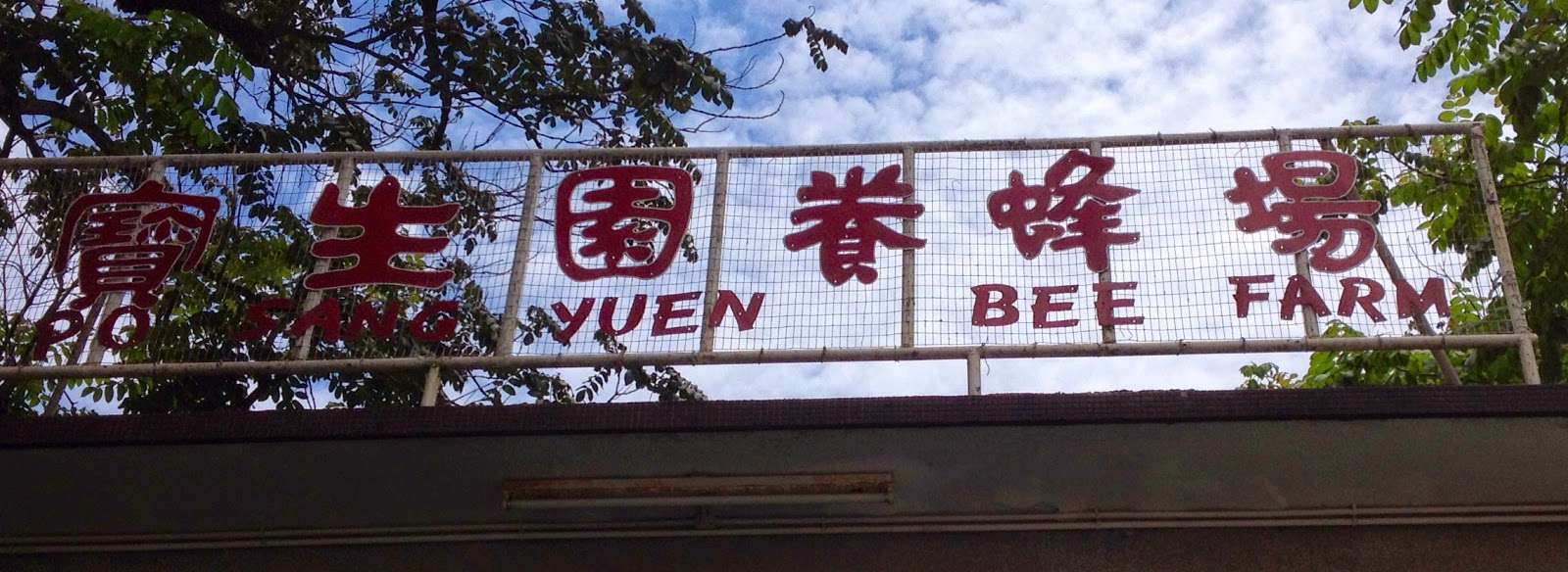
Po Sang Yuen Bee Farm

Edmund Leung at Po Sang Yuen Bee Farm
Asian bees guard a nest in a hollow tree
Although there is growing interest in keeping honey bees in Hong Kong, the hobby is constrained by space limitations throughout the city.  Nevertheless, there are hives scattered about on rooftops and in some green areas.  North of Hong Kong Island is the New Territories, the largest of Hong Kong's three regions.  Space constraints are less of an issue there; the region is home to two bee farms, so we decided to visit one.  The Po Sang Yuen Bee Farm is a short train ride north of Central Hong Kong.  After a five minute walk from the train station, we found it and met Edmund Leung who is the General Manager and grandson of the founder.  Edmund kindly showed us around and told us about his business.  The Bee Farm has over two thousand hives and is in business solely for the production of honey.  Their bees are Asian honey bees or Apis Cerana which are smaller and more docile than the western honey bees (or Apis Mellifera) that we keep in Minnesota.  In addition to their hives in the New Territories, the Bee Farm also has hives scattered around mainland China and in Chiang Mai, Thailand. 
Jars of Buckwheat and Lungan honey
Placing hives in different locations enables Po Sang Yuen Bee Farm to produce different types of honey because the variety of flowers and trees produce different nectars and pollens.  We recognized some of their honey varieties, like Buckwheat, but others, such as Lychee and Lungan were new to us.  Po Sang Yuen Bee Farm harvests comb honey from their hives in the New Territories, while honey is extracted and bottled from their hives in mainland China and Chiang Mai.
Bee hives at Po Sang Yuen Bee Farm

 
The honey season in Hong Kong is very different than what we're used to in Minnesota.  Because of the relatively mild climate, honey can be harvested a few times per year.  But Edmund explained that the biggest harvest is usually in early April.  Hives are just one box deep.  During the nectar flow, only one super is added to each hive to collect excess honey for harvesting, and it is usually on the hive for about three weeks.  Because the climate is so humid in Hong Kong, the nectar would not cure sufficiently to become honey if more supers were stacked on top of the hive.  In Minnesota by comparison, our hives are two or three boxes deep, and we might have four or even more supers on our hives for two months or even longer. 

Inside one of the hives at Po Sang Yuen Bee Farm
Like many bee keepers, Po Sang Yuen Bee Farm has had challenges with their bees.  Last year, they lost a significant number of their hives due to unusually cold and wet weather, a problem shared by other bee keepers in Hong Kong.  When they lose hives, they try to re-build by dividing the surviving hives and re-queening.

We are grateful for the time that Edmund spent with us to tell us about his bees and his business.  We wish him and Po Sang Yuen Bee Farm much luck and good fortune!
Founder of Po Sang Yuen Bee Farm
Poster at Po Sang Yuen Bee Farm