Friday, September 4, 2015

Going to Great Lengths


The Great Wall stretches over 13,000 miles across northern China
Long, steep sections of the Wall are lined with
battlements and connect watch towers
The history, size and sheer influence of the People's Republic of China typically evokes many different images, but likely none more famous than the Great Wall.  Although Jeff and I have traveled throughout Asia during our time in Hong Kong, our visits across the border to Mainland China have been limited for a few reasons. First, visa requirements for U.S. citizens were difficult until early this year, and air traffic conditions are notorious, leading to some spectacular delays at times. Finally, Jeff travels to the Mainland for business, and I've been reluctant to make him go back during his leisure time. Although I was able to visit a section of the Great Wall during a trip to China almost two years ago, it also occurred to me that spending two years in China without seeing it would be a big missed opportunity for Jeff. Recently, I convinced him to tack a weekend onto one of his business trips so I could join him, giving us both a chance to see the Great Wall and some of Beijing's other landmarks. 

The length of the Great Wall is one of its most striking features.  Stretching 13,171 miles through nine provinces across northern China, the length of the Wall is nearly five times the distance from Los Angeles to New York.  Its easternmost section starts in Liaoning Province along the Yalu River bordering North Korea where visitors are warned not to stray across the border lest they encounter well-armed and unwelcoming border guards. 
Periodic watch towers along the the Wall
provide spectacular views in all directions
From there, the Wall stretches west to Gansu Province, where its two final gates, Yumen Guan ("Jade Gate Pass") and Yang Guan ("Sun Pass") were trading posts along the Silk Road corridor that connected Asian merchants to those in the west. From its westernmost point, the end of the Great Wall sits just 1,600 miles from the border of Kazakhstan.

Initially, the Great Wall was a series of defensive barricades erected by various independent kingdoms to protect themselves from invasion by Eurasian nomadic tribes. The earliest sections of the Wall date to the 7th Century B.C.  Eventually these sections were joined together and ambitious extensions of the Great Wall were undertaken by the Qin (221-206 B.C.) and Ming (1368-1644) dynasties.  Although exact numbers will never be known, thousands of workers were involved in constructing the Wall over the years, many of them political prisoners.  The work was difficult and dangerous, and many of the workers perished on the job. The Travel China Guide reports that workers who died were simply buried in the Wall to save on funeral expenses, because the bones of the deceased made for good building materials and "to intimidate the avenging spirits of those who died."

The Great Wall at Mutianyu has undergone extensive restoration
The condition of the Great Wall varies dramatically across its length.  The passage of time, exposure to the elements and damage from humans have caused sections to disappear altogether.  At one point, even Mao Zedong encouraged peasants to raid the Wall as a source of building materials. The Wall was declared a UNESCO World Heritage site in 1987, and its cultural and economic value is clearly understood by the Chinese, who have been working to preserve and restore it since the early 1980s. The government has enacted a number of laws to protect it and launched efforts to reconstruct portions of it.  Most of the sections that remain today date from the Ming era.  Jeff and I visited a section of the Wall at Mutianyu, an area about 45 miles north of Beijing that is known for its beautiful scenery.
l
Access to Tiananmen Square was restricted, and the Forbidden City was closed for parade preparations
Our brief stay in Beijing was during the week leading up to a major military parade to celebrate the 70th anniversary of the victory over the Japanese in 1945.  As a result, central Beijing was in a virtual lockdown, with access to Tiananmen Square heavily restricted and the Forbidden City closed to visitors.  The elimination of those destinations from our agenda gave us a reason to explore a couple of other sites that were suggested by a colleague at work.
The Hall of Prayer for Good Harvest is an all-wood structure constructed without nails
On the south side of Beijing is the Temple of Heaven Park.  Dating to 1420, the Temple was used by the emperors of the Ming (1368-1644) and Qing (1644-1912) dynasties to worship and offer sacrifices to pray for a successful harvest.  At 675 acres, the park is larger than the Forbidden City and takes a few hours to visit.  Based on Confucian design principles, the temple is actually more of an altar than a traditional temple.  Most of the structures that survive in the park today date from the Qing era and include a mix of round temple halls and square bases methodically arranged within the park land that is scattered with 4,000 knotted cypress trees, some as old as 800 years.  The highlight of the park sits near the north end and is the Hall of Prayer for Good Harvest.  The original structure, which was built in 1420, burned after it was struck by lightning in 1889.  Reconstructed a year later, the replacement is considered to be a true representation of the original and is a beautiful, three-tiered, structure constructed entirely of wood, without the use of nails, atop a three-tiered marble base. 
The Imperial Vault of Heaven is surrounded by the Echo or "Whisper" Wall
About one-quarter mile to the south and connected by a raised walkway is the Imperial Vault of Heaven, a round pavilion that dates to 1530 and is surrounded by the Echo Wall.  Also known as the Whisper Wall, it is said that a whisper will travel from one end of its 633 feet and be clearly heard on the other end.  
Looking north from the Round Altar, which was designed around the number nine
At the southern end of the Temple of Heaven Park's north-south walkway is the Circular Mound (or Round) Altar, which also dates to 1530.  Rebuilt in 1740, it is an open, three-tiered structure of white marble designed around the number nine.  The Ancient Chinese believed that odd numbers represented masculinity and even numbers represented femininity.  As the single largest odd-numbered digit, nine was considered the ultimate in masculinity and therefore used extensively in Imperial-era construction as a means of reinforcing the sovereignty of the emperor. 
An incense burner at Yonghe Gong
A statue of Tsong Khapa, founder of Gelug Buddhism was
spared from destruction during the Cultural Revolution 
Beijing is not generally known for having great temples to visit, but it does have the distinction of being home to Yonghe Gong, one of the most renowned Tibetan Buddhist temples outside of Tibet. In Tibetan and Mongolian Buddhism, monks or spiritual leaders are referred to as Lamas. Because Yonghe Gong is a monastery, it is sometimes also referred to as "Yonghe Lamasery" or just "Lama Temple." Yonghe Gong means "palace of peace and harmony" which is fitting, given that its ornate structures create a calm setting within otherwise bustling Beijing. Dating to 1694, Yonghe Gong is made up of five Han Chinese and Tibetan halls filled with historic art.  Between the halls are peaceful courtyards containing smaller pavilions, incense burners, and prayer wheels.  During the Cultural Revolution, the Central Committee pursued a policy of destroying the "Four Olds" consisting of old customs, old culture, old habits and old ideas. Numerous temples were destroyed under this policy, but Yonghe Gong is said to have been spared due to the intervention of Premier Zhou Enlai. 
Chefs carve Beijing Duck at Jinbaiwan Roast Duck Shunyi Branch
Beijing Duck served with traditional condiments
Since our weekend was about experiencing Beijing, we decided we couldn't leave without trying out some Peking (or Beijing as it's now called) Duck. With a little online research, we found a restaurant that would give us a truly local experience.  When we arrived, we were pleased to discover we were the only Westerners there.  Although ordering our food involved a comedy of pointing, gesturing and picture-drawing, our efforts were rewarded with a delicious dinner.

It's not difficult to find reasons to avoid Beijing.  The prospect of air traffic delays, urban congestion, horrible air quality and government red tape add up to make make one feel like it may not be worth the effort.  But in our brief weekend there, we avoided most of these problems and were rewarded by seeing some of Beijing's most enduring landmarks without having to go to great lengths for the experience.   

Saturday, July 25, 2015

Gone to Guangdong

Guangzhou is a comfortable two hour train ride from Hong Kong
Jeff and I both had busy travel schedules in June.  I was back in the States for a couple of weeks, and Jeff had trips to China, Taiwan and the U.K.  As a result, neither of us had been very eager to get back on an airplane. But we are also conscious of the limited amount of time that remains before my work assignment here is over, and we want to see as much of the region as we can. Visiting Mainland China recently got much easier for us, courtesy of our new ten year, multi-entry visas.  So we decided to jump on a train for a short trip north to Guangdong Province.
The Five Rams Statue symbolizes the founding of the city of Guangzhou
With a population of more than 100 million, Guangdong (pronounced "gwang-dong") plays a significant role in the economic engine that is China.  For some perspective on this, Guangdong's population is roughly equal to the combined populations of California, Texas, New York and Florida.
The Flower Pagoda at the Temple of the Six Banyan Trees
This would rank the province among the twenty largest countries in the world, yet Guangdong still only represents about 8% of China's total population.  In terms of economic output, Guangdong is the largest of China's thirty-one provinces, municipalities and autonomous regions, accounting for about 12% of the entire country's output.  In Chinese, the term "guang" means "vast expanse" which is appropriate since the province occupies some 70,000 square miles along the southeastern coast of China, sharing its border with Hong Kong and Macau.  The Pearl River Delta is a prominent feature of the province.  Guangzhou (prounounced "gwang-jo"), Guangdong's capital city, is an important port city strategically located on the Pearl River, which is navigable to the South China Sea.  Formerly known as Canton, Guangzhou is the third largest city in China, after Beijing and Shanghai.  It was one was one of the early beneficiaries of China's economic reform policies that began in 1978, encouraging private business and gradually opening the country to foreign investment.  Indeed, close proximity to Hong Kong has positioned the city and the province well to benefit from trade with the west and investments by multinational companies establishing offices and production facilities there.
Guangzhou has a colorful skyline best viewed from the Pearl River
Our train trip was a comfortable, two hour ride, stopping just once between our departure from the rail station in Kowloon and arrival in Guangzhou.  Despite the relative sophistication of Guangzhou, we encountered some language barriers trying to find our hotel, but eventually got settled in.
The jade burial suit of King Zhao Mo is a featured
attraction at the Mausoleum of the Nanyue King
Our souvenir photo from the
Pearl River Night cruise
Guangzhou has an extensive metro system, which mercifully includes signage in English, so we set off to see our first stop, the Museum and Mausoleum of the Nanyue King.  Considered one of China's best museums, it is organized around the ancient tomb of Zhao Mo who ruled the kingdom of Nanyue which included parts of southern China and northern Vietnam.  Upon his death in 122 B.C., Zhao was buried in a jade burial suit in an elaborate tomb 66 feet underground containing over 1,000 artifacts, precious metals, a chariot and 15 courtiers who were buried alive for the purpose of serving Zhao during his afterlife.  The tomb was discovered in 1983; opening of the museum followed in 1988.

Guangzhou's thriving economy means that the city's center is densely packed with elaborately designed skyscrapers that are colorfully lit at night.  This has given rise to a thriving industry of cruise ships that operate on the Pearl River each night giving tourists the opportunity to view the spectacle from the river.  We signed up for a one-hour cruise and settled into our seats at a table we shared with a large family.  The ship had a professional photographer on board who spent the cruise loudly ordering passengers to pose in front of the Canton Tower, a landmark on the river's shoreline.  As the only westerners on board, we didn't realize until the cruise was nearly over and the photographer chased us down that the ticket fare included a photo of us.
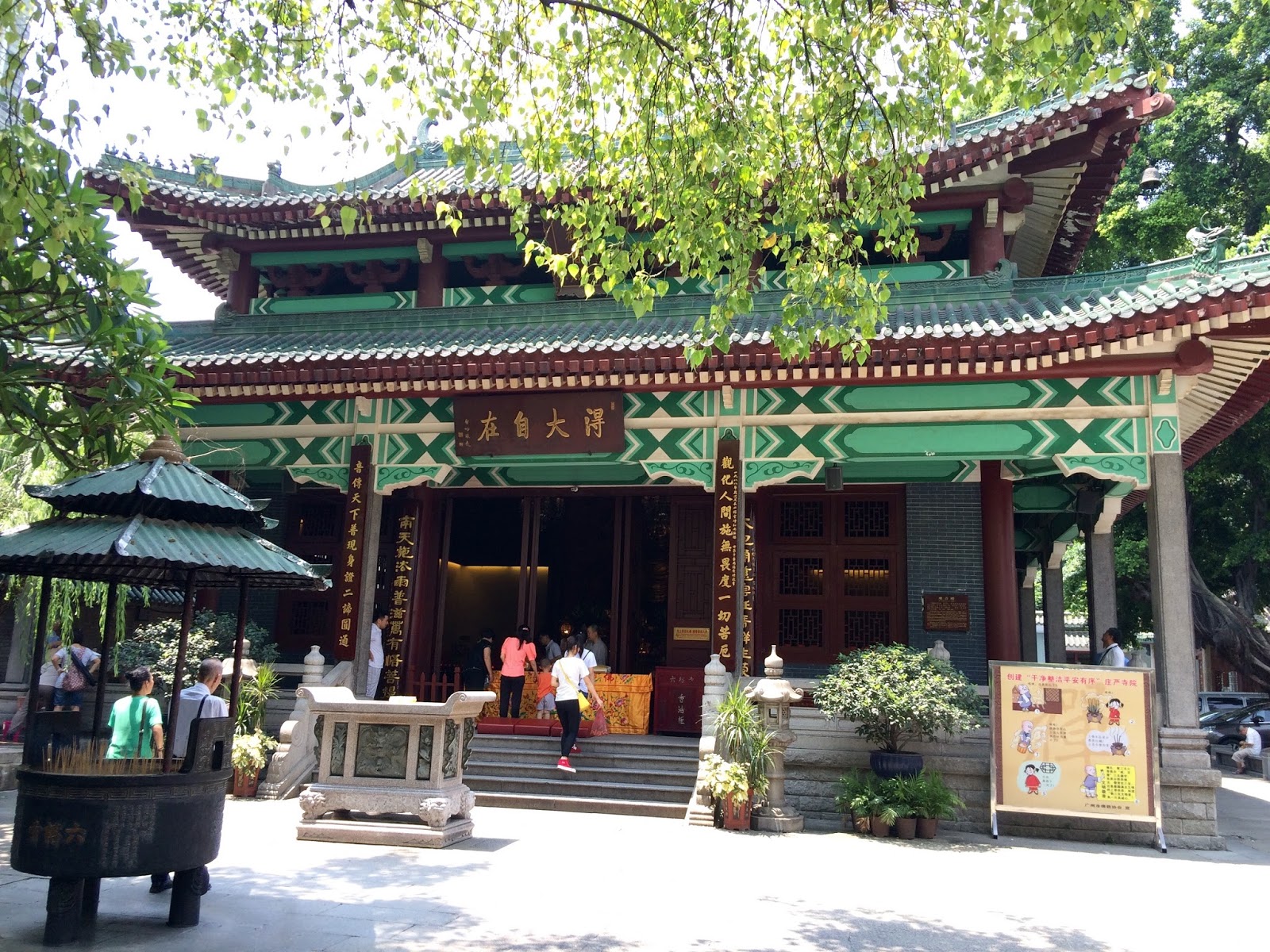
The Temple of the Six Banyan Trees is one of
four major Buddhist Temples in Guangzhou
Always in search of interesting temples, I learned that Guangzhou has four Buddhist Temples to visit.  The Temple of the Six Banyan Trees is one of the best known and has a long history, dating to 537 A.D.  Having been rebuilt over the years, the temple consists of several buildings that surround an octagonal pagoda.  Originally built in 1097, the existing pagoda dates from 1900 and contains Buddhist relics.

Our last stop in Guangzhou was the Chen Clan Ancestral Hall, a traditional Chinese academic temple complex consisting of nineteen buildings, nine halls and six courtyards.  Considered to be among the best examples of Lingnan Architecture, the buildings are known for their elaborate decoration, which includes wood and plaster carvings and iron engravings. 
The Chen Clan Ancestral Hall features pottery
sculptures on the ridges of the gabled roofs
The most notable feature is the pottery sculptures on the ridges of the gabled roofs that depict scenes from traditional Chinese dramas.  Completed in 1894, the Chen Clan Ancestral Hall now houses the Guangdong Folk Art Museum and contains both visiting exhibits and permanent collections of pottery, embroidery, porcelain, and wood and jade carving.
The Chen Clan Ancestral Hall is considered a prime example of Lingnan architecture
Being in Asia affords us more opportunities than we can possibly take advantage of before our time here ends.  But our visit to Guangdong and the relatively easy trip between there and Hong Kong was a good reminder that we needn't travel far to see new sites and learn more about Asia.

Saturday, July 4, 2015

A Visit From Maggie and E.J.

E.J. and Maggie enjoy barbeque pork buns at Tim Ho Wan
In May we received another visit from family.This time, my niece Maggie McCray and her boyfriend E.J. Crawford made the long trip from their home in Austin, Texas.  Their week in Hong Kong was marked by a lot of rain, but Maggie and E.J. dodged the downpours to see the sights. Although our time together went by too quickly, we were thrilled to have them here. This blog post was written by Maggie and contains their photos.

Well it's been a month now since E.J. and I had the chance to spend a week in Hong Kong. 
Neither of us had ever been to Asia before - and we had a great time experiencing this wild city!
It was such a crazy mash-up of East meets West and was a great beginner's version of Asia. We would love to come back and explore more. 
Fresh fish at North Point Wet Market
An assortment of dried seafood
I feel like we got to experience such a wide swath of the city - temples, dim sum, steep hills, beaches, subways, buses, fancy bars, egg tarts, tailors, foot rubs, gardens, red rain storms, night markets and more. I guess maybe it took me a month to recover! 
Maggie inspects tiles in Macau
Dodging the rain at 10,000
Buddhas Monastery

There were times that I easily felt like I could have been in New York City in lower Manhattan - narrow winding streets full of trendy bars and restaurants with English speaking ex-pats spilling out the doors. Then there were so many other moments that reminded me I was somewhere completely different - the temple under the stairs on Carolyn's commute to work, shopkeepers putting food at the shrines in front of their stores, the meat and fish displayed in windows, and all of the unexpected smells - incense and one that I kept smelling and could never place (definitely a spice we don't use here). 
A bowl of noodles at Tsim Chai Kee
E.J. tries a local soy drink


I was wowed by the incredible public transportation system - the multiple types of buses, trams, ferries and subways all paid for by the Octopus card. I also couldn't get over how well the MTR runs all of these services and how you can use your Octopus card at 7-11 and other small stores around the subway stations and cities. It makes all those impulse egg tarts even easier to eat. I especially loved the escalator that carries pedestrians downhill in the mornings and uphill in the evenings in the steepest part of the city. Genius!
Maggie & E.J. brave the weather to cross Victoria Harbour
for a view of Central Hong Kong from the Kowloon promenade
The rain that fell off and on for our entire visit really didn't slow down our sightseeing. I absolutely loved going to the 10,000 Buddhas Monastary and actually think that the rainy atmosphere made it even more amazing. Hiking up and down that steep tropical hill surrounded by the golden Arhan statues in the drizzle is one of my favorite memories of the trip. Our experience eating at the vegetarian restaurant at the temple was also memorable and hilarious - perhaps the first meal where I realized just how varied the soy products can be in a Hong Kong restaurant! 
Orchids at the Hong Kong Botanic Garden
E.J. makes a new friend


Speaking of rain, I was unprepared for the tropical landscape - this city that cascades down a mountain to an incredible harbor, skyscrapers surrounded by rubber trees and banyan trees and so many green leaves. We loved exploring the aviary and the botanical and zoological gardens (I've never seen such a collection of monkeys!!!) and going to see the Big Buddha in the middle of a jungle-covered island. 
An army of figurines at one of Hong Kong's many antique stores on Hollywood Road
We are so glad we made it to Hong Kong to visit - thanks for hosting us and showing us around!
Bicycle rickshaws await passengers

Incense coils burn at a temple

Saturday, May 16, 2015

More Buddhas in Bangkok

Buddha statues surround a stupa at Wat Yai Chaya Mongkol in Ayuthaya 
Jeff is slowly realizing that the number of Buddhist temples in Asia is almost unlimited, and I would be happy to visit them all and examine each and every statue of Buddha contained within them.   My fascination with Buddha statues only grows as I learn more about the significance of the subtle variations between them.  The Buddha's posture, the size of the hair knot, certain facial features and small details about the clothing can all be indicators of both the region and the period of a statue's origin.  Given the geographic spread and ancient history of Buddhism, this means a Buddha statue can have an interesting and sometimes surprising history.
Wat Pho features over 90 chedi decorated with Chinese porcelain enamel
The term Wat is a Sanskrit word that means Buddhist place of worship, and it is typically used in Thailand, Cambodia and Laos. Wats are basically temple compounds, typically made up of multiple structures, including stupas or chedi (containing ashes of Buddhist Monks or other relics), a prayer room (vihear), a pavillion (sala), an ordination hall, a library, a bell or drum tower and living quarters for Buddhist Monks.  With a population that is 95% Buddhist, Thailand has some of the most elaborate and beautiful Wats to visit and no shortage of Buddha statues to examine.  Last fall, Jeff and I spent a week in southern Thailand, but we stayed at the beach on a remote island and didn't have the opportunity to visit any Wats.  We wanted a chance to see a cultural dimension of Thailand, so we decided to return and spend a weekend in Bangkok.
Intricate sculptures surround the ordination hall at Wat Phra Kaew
On this trip, we only had two days, and we had heard that Bangkok has notoriously difficult traffic. Indeed, when I remarked on the lengthy wait at a stop light, the taxi driver replied: "Madame, no traffic, no Bangkok."  Although there are over 400 Wats to see in Bangkok, we were daunted by the logistical challenges, so we focused our first day on the three most famous Wats sitting along the Chao Phraya River that flows through the city.

Wat Pho's granite sculptures are a legacy of trade relations with China
Wat Phra Kaew contains many elaborate structures, but is best known for the Emerald Buddha, a Buddha statue that dates to 1464, is 26 inches high and is carved entirely from a single nephrite (or jade) stone.  The Wat is located within the Grand Place, a former residence of the Thai monarch.  With over 100 structures spread across more than 200 acres, the Grand Palace and Wat Phra Kaew are popular and heavily visited sites.
The reclining Buddha at Wat Pho is over 150 feet in length
and has enormous toes with toe prints on the bottom
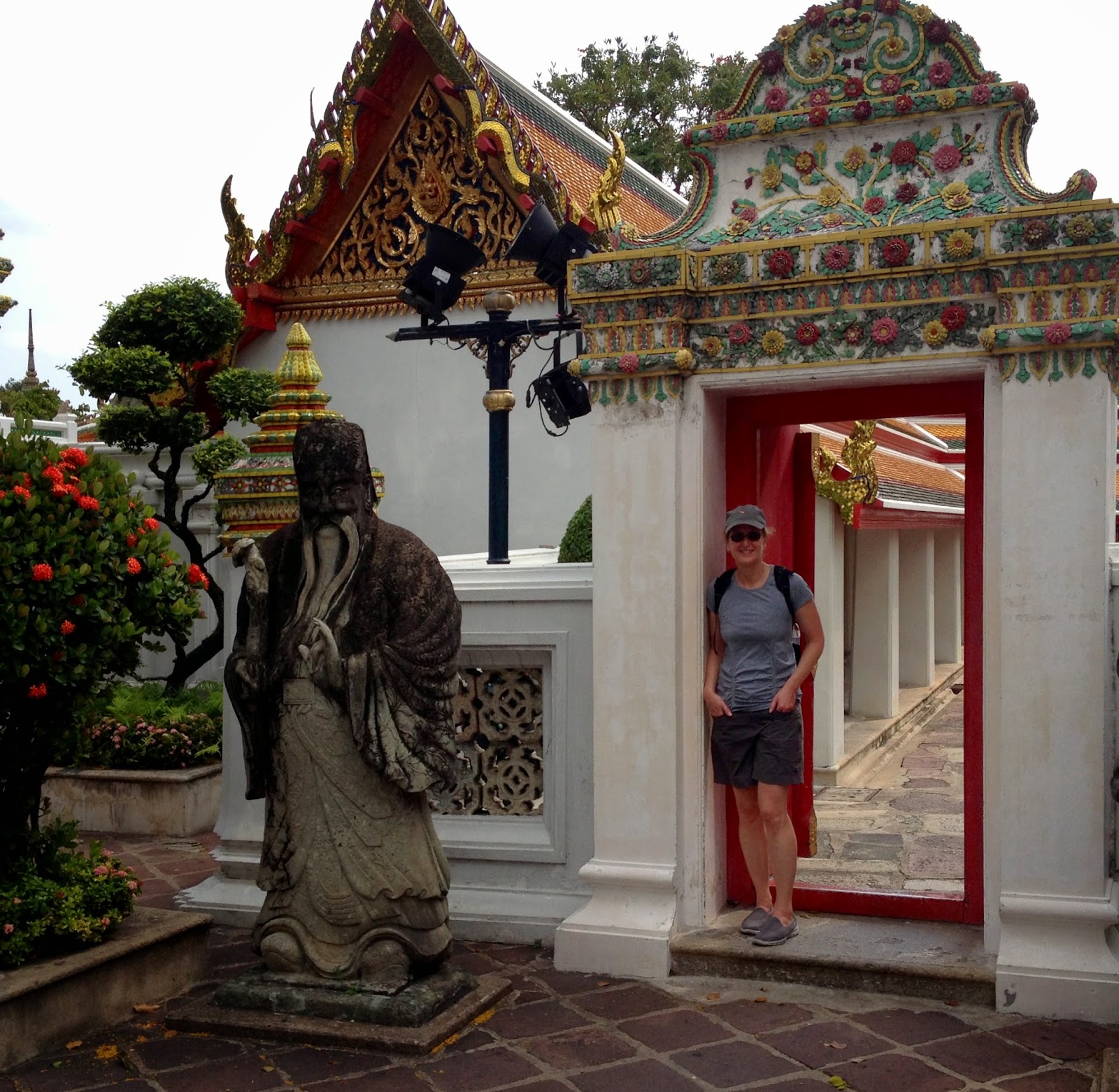
Our next stop was Wat Pho which proved to be our favorite.  Dating to 1788 and covering 20 acres, Wat Pho has fewer visitors and a much more relaxed atmosphere.   We were able to get a close-up look at this temple's most famous feature:  a reclining Buddha statue that is finished in gold leaf, extending more 150 feet in length and symbolizing the passing of Buddha into nirvana.  Wat Pho also contains another 1,000 Buddha statues, 91 chedi spires and an assortment of carved granite statues.  The statues, along with the colorful porcelain enamel decoration on the chedi, are a legacy of trade with the Chinese; the granite statues were actually transported to Thailand as ballast in Chinese junks.
Buddhist monks chanting in the evening at Wat Arun
Dating to the mid-1600s, Wat Arun sits majestically on the edge of the river, its famous spire highly visible and beautifully lit at night.  It is currently undergoing restoration, so its intricate Chinese porcelain enamel decoration was difficult to see under the scaffolding wrapped around the spire. Named for the Hindu god Aruna, Wat Arun at one time housed the Emerald Buddha and is one of just a few Buddhist temples that visitors can climb.
Flowers for temple offerings are sold at the Bangkok flower market
We capped off our day of visiting Wats with a nighttime bicycle tour through the city.  Admittedly, we had a brief "what were we thinking" moment as we contemplated riding through Bangkok's chaotic traffic in the dark.  But the group was small - only six of us - plus our leader, and she expertly led us through narrow alleys and small neighborhoods to visit the wholesale flower market.
Jeff walks through stalls filled with Marigolds at the Bangkok flower market
The market kicks into full swing in the evenings when hotels, restaurants and Wat vendors (who sell flowers for making offerings) make their purchases for the next day.  Flower shops spilling over with millions of Marigolds, Jasmine, Lotus and Orchids cram both sides of the road, and the air is filled with a confusion of smells, as the scent of all the flowers mixes with aromas from the food carts lining the road.
The ruins at Ayuthaya
Buddha statues among the ruins
at Wat Yai Chaya Mongkol

For our second day in Bangkok, we decided to escape the city and head north about about 45 miles to Ayuthaya (pronounced "I-you-tee-ah"), a wealthy and important kingdom within Siam from 1350 until the late 1760s when it was invaded and looted by the Burmese.  We visited the ruins of the former capital, which are now a UNESCO World Heritage Site, as well as Wat Yai Chaya Mongkol, a temple complex that dates to the 13th Century.  Both sites provided us with numerous structures to wander through and climb, as well as a peaceful break from the busy pace of Bangkok.

Bangkok is a busy place, but filled with many beautiful treasures.  The elaborate architecture and decoration of the Wats are truly a feast for the eyes.  Our weekend there was a great opportunity for me to feed my fascination with Buddha statues and for Jeff to continue to demonstrate his patience as he realizes how much there is to understand about their detail.

Friday, May 8, 2015

A Tale of Two Chinas

Jhushan Village on Kinmen Island, Taiwan dates to 1345 is arranged according to feng shui
As we progress through our second year in Hong Kong, Jeff and I have started giving more thought to our "bucket list" of destinations in Asia to visit before our time here is over.  Two of those destinations are Japan and Taiwan.  While Jeff had been to both for business, he never had time to do any sightseeing, and I had never visited either country. So in April we took a week off and spent a few days in each country.
 
Jeff stands in the entrance of home-stay inn in Jhushan Village


Kinmen's network of civil defense tunnels
offered protection during Communist shelling
Americans typically don't give much thought to the stability and status of our government, so it's hard to imagine what it must be like to be a citizen of a country that is unrecognized by much of the World. The Republic of China (ROC) was established in what is now the People's Republic of China (PRC) in 1912, following the end of the Qing Dynasty. At that time, Taiwan was known as Formosa and was ruled by Japan.  Following World War II, Taiwan and surrounding islands were returned to the Allied Forces and the ROC.  The Nationalist Party, led by Chiang Kai-shek, controlled the ROC, but had a longstanding conflict with the Communist Party.   The two parties joined forces during World War II to resist the Japanese, only to resume their civil war in 1946.  Upon defeat by the Communist Party in 1949, the Nationalist Party government retreated to Taipei and established that city as a provisional capital.  Chiang resumed his role as President and maintained his intention to retake the Mainland until his death in 1975.  For its part, the Communist Party established the People's Republic of China on October 1, 1949 and still actively claims Taiwan as part of its territory to this day.  Until 1971, the ROC was recognized as the sole legitimate government of China by the UN and most Western countries.  However, UN recognition of the PRC in 1971 triggered the ROC's ultimate expulsion from the UN.  Since that time, the "One China" policy has resulted in the reduction of countries recognizing the ROC from 71 in 1969 to just 22 in 2013, while recognition of the PRC has grown from 48 to 172 countries over the same period. 

The Jugang Tower was built as a memorial to the fallen soldiers of Kinmen 

When ROC forces retreated to Taiwan island, they retained control over two islands in the Taiwan Straits: Quemoy (or Kinmen) and Matsu.  Control of these islands, which are located much closer to the coast of the PRC than to Taiwan, proved to be of both strategic and political importance in the standoff.   Quemoy sits less than two miles from the PRC coast and was first shelled by the Communists in 1954.  The U.S., which viewed ROC control over Quemoy and Matsu as critical in containing the spread of Communism in Asia, responded by threatening the use of nuclear weapons against the Mainland.   A second round of shelling by the Communists in 1958 led to another crisis, during which the U.S. military's supply of weapons simply outlasted the Communists'.  Following this, the two sides continued to shell each other until 1979, with leaflets and propaganda replacing explosives in many of the shells. 

Chen Ching Lan Mansion is an example of western architecture on Kinmen

After years as a military reserve under martial law, administration of Quemoy was transferred from military to civilian government in the 1990s.  And as tensions between the ROC and PRC waned, Quemoy eventually became a tourist destination, with direct travel between the island and the Mainland beginning in 2001.

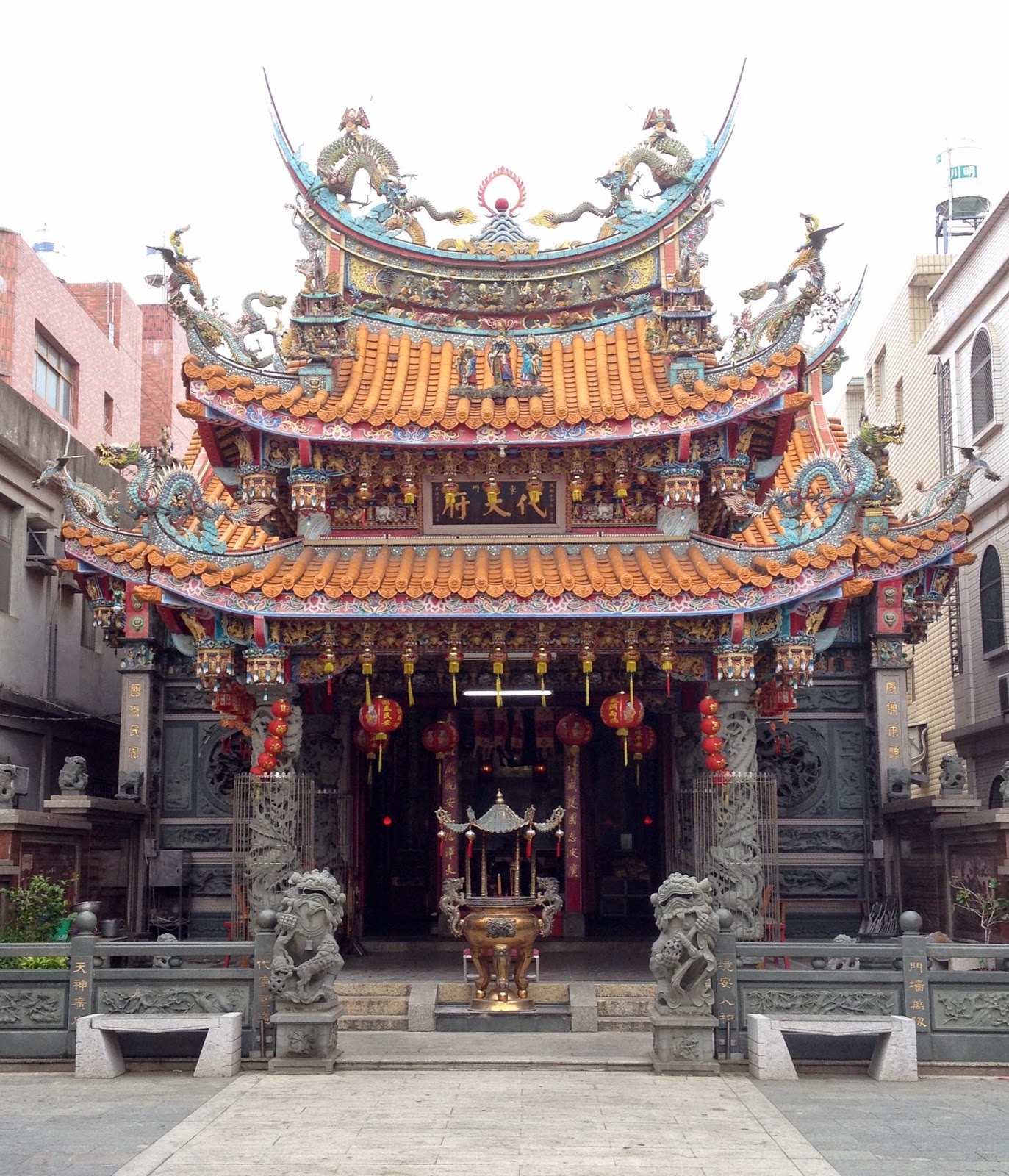
One of the many elaborate temples on Kinmen
Jeff and I traveled to Quemoy on a one hour flight from Taipei.  And although the island's military history is still evident, it does not interfere with its lush, green beauty or the kindness of the 130,000 people who call it home.  The economy is supported primarily by tourism, followed by the production of Kaoliang or sorghum wine, agriculture and fishing.  The surplus of steel left over from the years of shelling gave rise to "bombshell cutlery."  The Maestro Wu steel knife factory got its start making knives from bombshells dropped by the Allies during World War II when Taiwan was occupied by the Japanese.  Today the company uses remnants from the Communist shelling as its main supply of steel for its knives.  Jeff and I visited the factory, saw a demonstration of how the knives are made and did a little shopping.  Maestro Wu estimates that the bomb shells left over from the Communist shelling will supply steel for making knives for another sixty years! 

Steel bomb shells are raw materials at the Maestro Wu steel knife factory

During our visit to Quemoy, we found the island to be very tourist-friendly.  Bicycles are free of charge for up to three days, and we used them to cycle around most of the island. In addition to the knife factory, we visited temples, beaches and the civil defense tunnels villagers used during the Communist shelling.  Quemoy villages are considered to be some of the best examples of traditional, clan-style dwellings in Taiwan.  There is an extensive network of "home stay" inns, and we stayed in one in Jhushan, a 14th Century village known for its houses with elegant swallow-tail roofs arranged according to feng shui.

Now that we have been in Hong Kong for just a little more than one year, we have learned that there are numerous cultures and histories that make up China.  While Taiwan is the China at the center of 20th Century political and military history and the line past which Communism did not spread, it goes without official recognition by most of the rest of the world.  Our trip to Quemoy gave us the opportunity to see up close where much of this history took place.

Saturday, May 2, 2015

Nepal Update

Jeff and I had the privilege of visiting Nepal in February, so we are closely following the developments there following last weekend's massive earthquake.  There are just no words to adequately describe the tragic loss of so many lives and the destruction of so many historic and unique buildings and monuments.  But we are happy to report that our friends who live in Kathmandu are safe.

During our visit to Nepal, we met Satish Kharel (9N1AA), Nepal's first native licensed amateur radio operator and his daughter Tejaswita (9N1DX), currently Nepal's youngest amateur.  We have heard from both of them by email.  Satish and his family are safe, and their house is intact.  Following natural disasters, amateur radio operators frequently step up to provide the critical communications needed to support rescue operations.  Satish has been very active since the quake and was featured in an interview on The Weather Channel.  (Stash's interviews starts about 1:45 into the video.)

We have also heard from Father Greg Sharkey, a Culver Military Academy classmate of Jeff's and a Jesuit who has lived in Nepal for more than thirty years.  The Jesuits have a well-established rural mobile health program in Nepal, and they are leveraging that program, along with their partner organizations, to deliver relief in remote villages.   The Midwest Jesuits have established a fund to support the relief efforts, and all of the funds are used directly to provide goods and services in person-to-person operations run by Jesuits.  If you are considering a donation to support the earthquake relief efforts in Nepal, this is a good option.  With their many years of experience in Nepal, the Jesuits will use the funds very efficiently and maximize their impact, no matter how large or small the contribution.  Donations can be made at this website.
Our blog post from our trip in February can be found here.  The video below is from our trip to Nepal in February and contains photos of the beautiful places we saw and the very kind people we met.