Saturday, July 4, 2015

A Visit From Maggie and E.J.

E.J. and Maggie enjoy barbeque pork buns at Tim Ho Wan
In May we received another visit from family.This time, my niece Maggie McCray and her boyfriend E.J. Crawford made the long trip from their home in Austin, Texas.  Their week in Hong Kong was marked by a lot of rain, but Maggie and E.J. dodged the downpours to see the sights. Although our time together went by too quickly, we were thrilled to have them here. This blog post was written by Maggie and contains their photos.

Well it's been a month now since E.J. and I had the chance to spend a week in Hong Kong. 
Neither of us had ever been to Asia before - and we had a great time experiencing this wild city!
It was such a crazy mash-up of East meets West and was a great beginner's version of Asia. We would love to come back and explore more. 
Fresh fish at North Point Wet Market
An assortment of dried seafood
I feel like we got to experience such a wide swath of the city - temples, dim sum, steep hills, beaches, subways, buses, fancy bars, egg tarts, tailors, foot rubs, gardens, red rain storms, night markets and more. I guess maybe it took me a month to recover! 
Maggie inspects tiles in Macau
Dodging the rain at 10,000
Buddhas Monastery

There were times that I easily felt like I could have been in New York City in lower Manhattan - narrow winding streets full of trendy bars and restaurants with English speaking ex-pats spilling out the doors. Then there were so many other moments that reminded me I was somewhere completely different - the temple under the stairs on Carolyn's commute to work, shopkeepers putting food at the shrines in front of their stores, the meat and fish displayed in windows, and all of the unexpected smells - incense and one that I kept smelling and could never place (definitely a spice we don't use here). 
A bowl of noodles at Tsim Chai Kee
E.J. tries a local soy drink


I was wowed by the incredible public transportation system - the multiple types of buses, trams, ferries and subways all paid for by the Octopus card. I also couldn't get over how well the MTR runs all of these services and how you can use your Octopus card at 7-11 and other small stores around the subway stations and cities. It makes all those impulse egg tarts even easier to eat. I especially loved the escalator that carries pedestrians downhill in the mornings and uphill in the evenings in the steepest part of the city. Genius!
Maggie & E.J. brave the weather to cross Victoria Harbour
for a view of Central Hong Kong from the Kowloon promenade
The rain that fell off and on for our entire visit really didn't slow down our sightseeing. I absolutely loved going to the 10,000 Buddhas Monastary and actually think that the rainy atmosphere made it even more amazing. Hiking up and down that steep tropical hill surrounded by the golden Arhan statues in the drizzle is one of my favorite memories of the trip. Our experience eating at the vegetarian restaurant at the temple was also memorable and hilarious - perhaps the first meal where I realized just how varied the soy products can be in a Hong Kong restaurant! 
Orchids at the Hong Kong Botanic Garden
E.J. makes a new friend


Speaking of rain, I was unprepared for the tropical landscape - this city that cascades down a mountain to an incredible harbor, skyscrapers surrounded by rubber trees and banyan trees and so many green leaves. We loved exploring the aviary and the botanical and zoological gardens (I've never seen such a collection of monkeys!!!) and going to see the Big Buddha in the middle of a jungle-covered island. 
An army of figurines at one of Hong Kong's many antique stores on Hollywood Road
We are so glad we made it to Hong Kong to visit - thanks for hosting us and showing us around!
Bicycle rickshaws await passengers

Incense coils burn at a temple

Saturday, May 16, 2015

More Buddhas in Bangkok

Buddha statues surround a stupa at Wat Yai Chaya Mongkol in Ayuthaya 
Jeff is slowly realizing that the number of Buddhist temples in Asia is almost unlimited, and I would be happy to visit them all and examine each and every statue of Buddha contained within them.   My fascination with Buddha statues only grows as I learn more about the significance of the subtle variations between them.  The Buddha's posture, the size of the hair knot, certain facial features and small details about the clothing can all be indicators of both the region and the period of a statue's origin.  Given the geographic spread and ancient history of Buddhism, this means a Buddha statue can have an interesting and sometimes surprising history.
Wat Pho features over 90 chedi decorated with Chinese porcelain enamel
The term Wat is a Sanskrit word that means Buddhist place of worship, and it is typically used in Thailand, Cambodia and Laos. Wats are basically temple compounds, typically made up of multiple structures, including stupas or chedi (containing ashes of Buddhist Monks or other relics), a prayer room (vihear), a pavillion (sala), an ordination hall, a library, a bell or drum tower and living quarters for Buddhist Monks.  With a population that is 95% Buddhist, Thailand has some of the most elaborate and beautiful Wats to visit and no shortage of Buddha statues to examine.  Last fall, Jeff and I spent a week in southern Thailand, but we stayed at the beach on a remote island and didn't have the opportunity to visit any Wats.  We wanted a chance to see a cultural dimension of Thailand, so we decided to return and spend a weekend in Bangkok.
Intricate sculptures surround the ordination hall at Wat Phra Kaew
On this trip, we only had two days, and we had heard that Bangkok has notoriously difficult traffic. Indeed, when I remarked on the lengthy wait at a stop light, the taxi driver replied: "Madame, no traffic, no Bangkok."  Although there are over 400 Wats to see in Bangkok, we were daunted by the logistical challenges, so we focused our first day on the three most famous Wats sitting along the Chao Phraya River that flows through the city.

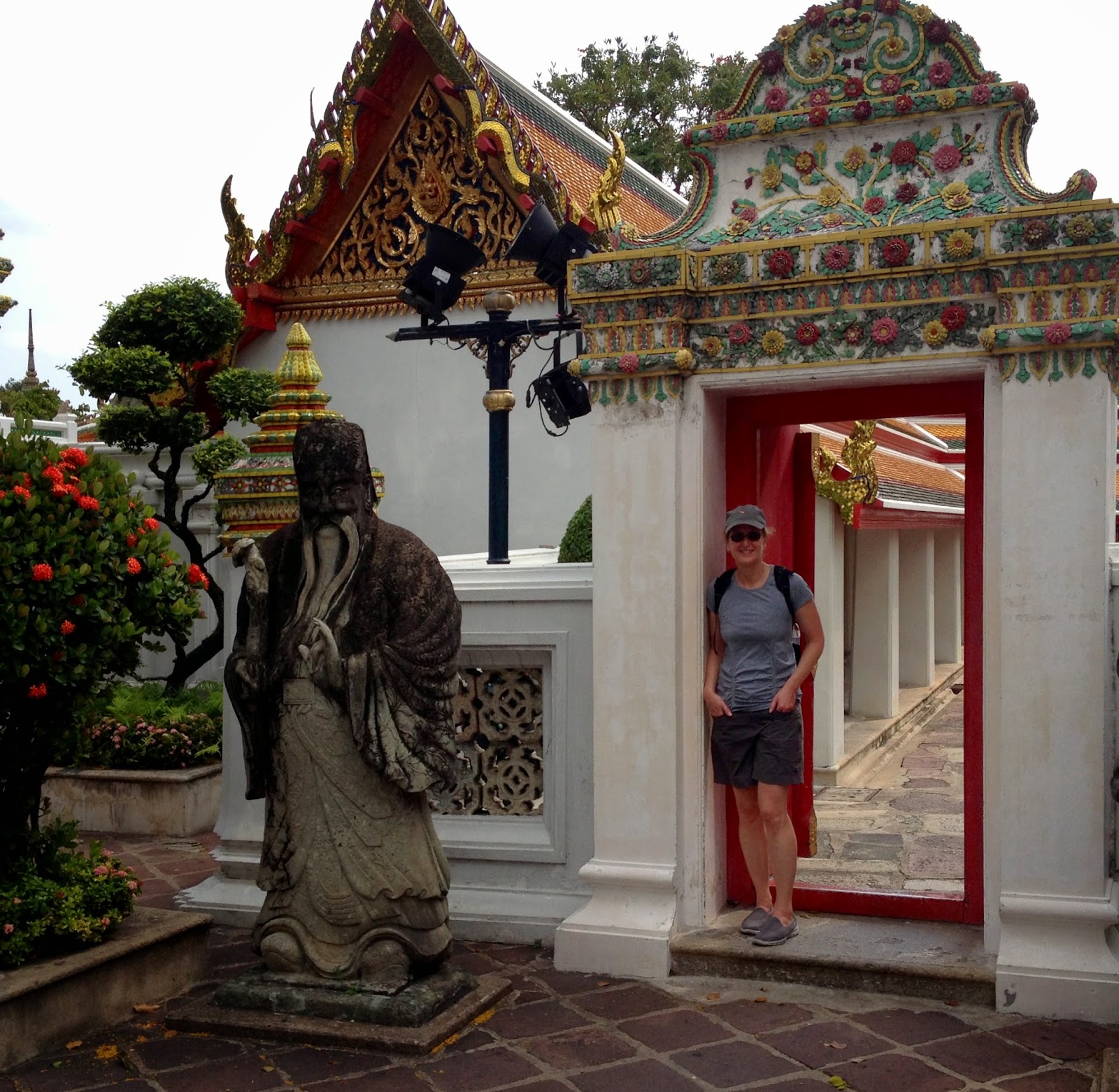
Wat Pho's granite sculptures are a legacy of trade relations with China
Wat Phra Kaew contains many elaborate structures, but is best known for the Emerald Buddha, a Buddha statue that dates to 1464, is 26 inches high and is carved entirely from a single nephrite (or jade) stone.  The Wat is located within the Grand Place, a former residence of the Thai monarch.  With over 100 structures spread across more than 200 acres, the Grand Palace and Wat Phra Kaew are popular and heavily visited sites.
The reclining Buddha at Wat Pho is over 150 feet in length
and has enormous toes with toe prints on the bottom
Our next stop was Wat Pho which proved to be our favorite.  Dating to 1788 and covering 20 acres, Wat Pho has fewer visitors and a much more relaxed atmosphere.   We were able to get a close-up look at this temple's most famous feature:  a reclining Buddha statue that is finished in gold leaf, extending more 150 feet in length and symbolizing the passing of Buddha into nirvana.  Wat Pho also contains another 1,000 Buddha statues, 91 chedi spires and an assortment of carved granite statues.  The statues, along with the colorful porcelain enamel decoration on the chedi, are a legacy of trade with the Chinese; the granite statues were actually transported to Thailand as ballast in Chinese junks.
Buddhist monks chanting in the evening at Wat Arun
Dating to the mid-1600s, Wat Arun sits majestically on the edge of the river, its famous spire highly visible and beautifully lit at night.  It is currently undergoing restoration, so its intricate Chinese porcelain enamel decoration was difficult to see under the scaffolding wrapped around the spire. Named for the Hindu god Aruna, Wat Arun at one time housed the Emerald Buddha and is one of just a few Buddhist temples that visitors can climb.
Flowers for temple offerings are sold at the Bangkok flower market
We capped off our day of visiting Wats with a nighttime bicycle tour through the city.  Admittedly, we had a brief "what were we thinking" moment as we contemplated riding through Bangkok's chaotic traffic in the dark.  But the group was small - only six of us - plus our leader, and she expertly led us through narrow alleys and small neighborhoods to visit the wholesale flower market.
Jeff walks through stalls filled with Marigolds at the Bangkok flower market
The market kicks into full swing in the evenings when hotels, restaurants and Wat vendors (who sell flowers for making offerings) make their purchases for the next day.  Flower shops spilling over with millions of Marigolds, Jasmine, Lotus and Orchids cram both sides of the road, and the air is filled with a confusion of smells, as the scent of all the flowers mixes with aromas from the food carts lining the road.
The ruins at Ayuthaya
Buddha statues among the ruins
at Wat Yai Chaya Mongkol

For our second day in Bangkok, we decided to escape the city and head north about about 45 miles to Ayuthaya (pronounced "I-you-tee-ah"), a wealthy and important kingdom within Siam from 1350 until the late 1760s when it was invaded and looted by the Burmese.  We visited the ruins of the former capital, which are now a UNESCO World Heritage Site, as well as Wat Yai Chaya Mongkol, a temple complex that dates to the 13th Century.  Both sites provided us with numerous structures to wander through and climb, as well as a peaceful break from the busy pace of Bangkok.

Bangkok is a busy place, but filled with many beautiful treasures.  The elaborate architecture and decoration of the Wats are truly a feast for the eyes.  Our weekend there was a great opportunity for me to feed my fascination with Buddha statues and for Jeff to continue to demonstrate his patience as he realizes how much there is to understand about their detail.

Friday, May 8, 2015

A Tale of Two Chinas

Jhushan Village on Kinmen Island, Taiwan dates to 1345 is arranged according to feng shui
As we progress through our second year in Hong Kong, Jeff and I have started giving more thought to our "bucket list" of destinations in Asia to visit before our time here is over.  Two of those destinations are Japan and Taiwan.  While Jeff had been to both for business, he never had time to do any sightseeing, and I had never visited either country. So in April we took a week off and spent a few days in each country.
 
Jeff stands in the entrance of home-stay inn in Jhushan Village


Kinmen's network of civil defense tunnels
offered protection during Communist shelling
Americans typically don't give much thought to the stability and status of our government, so it's hard to imagine what it must be like to be a citizen of a country that is unrecognized by much of the World. The Republic of China (ROC) was established in what is now the People's Republic of China (PRC) in 1912, following the end of the Qing Dynasty. At that time, Taiwan was known as Formosa and was ruled by Japan.  Following World War II, Taiwan and surrounding islands were returned to the Allied Forces and the ROC.  The Nationalist Party, led by Chiang Kai-shek, controlled the ROC, but had a longstanding conflict with the Communist Party.   The two parties joined forces during World War II to resist the Japanese, only to resume their civil war in 1946.  Upon defeat by the Communist Party in 1949, the Nationalist Party government retreated to Taipei and established that city as a provisional capital.  Chiang resumed his role as President and maintained his intention to retake the Mainland until his death in 1975.  For its part, the Communist Party established the People's Republic of China on October 1, 1949 and still actively claims Taiwan as part of its territory to this day.  Until 1971, the ROC was recognized as the sole legitimate government of China by the UN and most Western countries.  However, UN recognition of the PRC in 1971 triggered the ROC's ultimate expulsion from the UN.  Since that time, the "One China" policy has resulted in the reduction of countries recognizing the ROC from 71 in 1969 to just 22 in 2013, while recognition of the PRC has grown from 48 to 172 countries over the same period. 

The Jugang Tower was built as a memorial to the fallen soldiers of Kinmen 

When ROC forces retreated to Taiwan island, they retained control over two islands in the Taiwan Straits: Quemoy (or Kinmen) and Matsu.  Control of these islands, which are located much closer to the coast of the PRC than to Taiwan, proved to be of both strategic and political importance in the standoff.   Quemoy sits less than two miles from the PRC coast and was first shelled by the Communists in 1954.  The U.S., which viewed ROC control over Quemoy and Matsu as critical in containing the spread of Communism in Asia, responded by threatening the use of nuclear weapons against the Mainland.   A second round of shelling by the Communists in 1958 led to another crisis, during which the U.S. military's supply of weapons simply outlasted the Communists'.  Following this, the two sides continued to shell each other until 1979, with leaflets and propaganda replacing explosives in many of the shells. 

Chen Ching Lan Mansion is an example of western architecture on Kinmen

After years as a military reserve under martial law, administration of Quemoy was transferred from military to civilian government in the 1990s.  And as tensions between the ROC and PRC waned, Quemoy eventually became a tourist destination, with direct travel between the island and the Mainland beginning in 2001.

One of the many elaborate temples on Kinmen
Jeff and I traveled to Quemoy on a one hour flight from Taipei.  And although the island's military history is still evident, it does not interfere with its lush, green beauty or the kindness of the 130,000 people who call it home.  The economy is supported primarily by tourism, followed by the production of Kaoliang or sorghum wine, agriculture and fishing.  The surplus of steel left over from the years of shelling gave rise to "bombshell cutlery."  The Maestro Wu steel knife factory got its start making knives from bombshells dropped by the Allies during World War II when Taiwan was occupied by the Japanese.  Today the company uses remnants from the Communist shelling as its main supply of steel for its knives.  Jeff and I visited the factory, saw a demonstration of how the knives are made and did a little shopping.  Maestro Wu estimates that the bomb shells left over from the Communist shelling will supply steel for making knives for another sixty years! 

Steel bomb shells are raw materials at the Maestro Wu steel knife factory

During our visit to Quemoy, we found the island to be very tourist-friendly.  Bicycles are free of charge for up to three days, and we used them to cycle around most of the island. In addition to the knife factory, we visited temples, beaches and the civil defense tunnels villagers used during the Communist shelling.  Quemoy villages are considered to be some of the best examples of traditional, clan-style dwellings in Taiwan.  There is an extensive network of "home stay" inns, and we stayed in one in Jhushan, a 14th Century village known for its houses with elegant swallow-tail roofs arranged according to feng shui.

Now that we have been in Hong Kong for just a little more than one year, we have learned that there are numerous cultures and histories that make up China.  While Taiwan is the China at the center of 20th Century political and military history and the line past which Communism did not spread, it goes without official recognition by most of the rest of the world.  Our trip to Quemoy gave us the opportunity to see up close where much of this history took place.

Saturday, May 2, 2015

Nepal Update

Jeff and I had the privilege of visiting Nepal in February, so we are closely following the developments there following last weekend's massive earthquake.  There are just no words to adequately describe the tragic loss of so many lives and the destruction of so many historic and unique buildings and monuments.  But we are happy to report that our friends who live in Kathmandu are safe.

During our visit to Nepal, we met Satish Kharel (9N1AA), Nepal's first native licensed amateur radio operator and his daughter Tejaswita (9N1DX), currently Nepal's youngest amateur.  We have heard from both of them by email.  Satish and his family are safe, and their house is intact.  Following natural disasters, amateur radio operators frequently step up to provide the critical communications needed to support rescue operations.  Satish has been very active since the quake and was featured in an interview on The Weather Channel.  (Stash's interviews starts about 1:45 into the video.)

We have also heard from Father Greg Sharkey, a Culver Military Academy classmate of Jeff's and a Jesuit who has lived in Nepal for more than thirty years.  The Jesuits have a well-established rural mobile health program in Nepal, and they are leveraging that program, along with their partner organizations, to deliver relief in remote villages.   The Midwest Jesuits have established a fund to support the relief efforts, and all of the funds are used directly to provide goods and services in person-to-person operations run by Jesuits.  If you are considering a donation to support the earthquake relief efforts in Nepal, this is a good option.  With their many years of experience in Nepal, the Jesuits will use the funds very efficiently and maximize their impact, no matter how large or small the contribution.  Donations can be made at this website.

Our blog post from our trip in February can be found here.  The video below is from our trip to Nepal in February and contains photos of the beautiful places we saw and the very kind people we met.


Sunday, April 12, 2015

It's Chau Time!

Tung Ping Chau sits in far northeastern Hong Kong
The fact that neither Jeff nor I speak Cantonese is rarely a major issue for us here in Hong Kong.  English is actually an official language here, and the sheer number of foreigners living here means that most signage, documents, websites and other sources of information are usually available in English.  Even the locals that don't speak English seem to have ways of communicating that enables them to address just about any situation that might arise.  In our day to day lives, we constantly read Chinese words that are written in English characters, and we frequently don't take the time to understand the meaning of them. 
Tung Ping Chau is one of Hong Kong's eight Geoparks
Hiking trails circumnavigate the island

But every once in awhile, the proverbial light bulb goes off and the meaning of one of those words suddenly becomes obvious to us.  Recently, that happened with the word "chau."  We suddenly noticed that many of the more than 200 islands that make up Hong Kong have the word "chau" in their names, so we concluded that "chau" must mean "island" in Cantonese.  When I asked a colleague at work if that was correct, she confirmed that it is, but added that it's actually pronounced "tsau," with more of a "t" sound at the beginning, not with the "ch" sound as the word is spelled in English.  She also volunteered that Chinese speakers are frequently confused by the English spelling of Chinese words as they often are different than the Cantonese pronunciation.

The meaning of the word "chau" became obvious to us because we enjoy exploring Hong Kong's
various outlying islands during our free time on the weekends.  Frequent and inexpensive ferry services between the islands provide an easy way to get away from chaotic Central Hong Kong and enjoy the peace and quiet offered by the less-crowded and automobile-free islands.
Sedimentary rocks line Tung Ping Chau's coastline

Many of these islands are a just a short ferry ride from Central and have at least a small population of permanent residents.  But one island was particularly intriguing to us due to its remote location and interesting history.
Hiking trails run through a bamboo jungle in the center of the island
Tung Ping Chau sits in far northeastern Hong Kong.   Just 2.5 miles from the coast of the Guangdong Province, the island is actually closer to Mainland China than the rest of Hong Kong.  At less than half a square mile in size, it's a fairly small island, and a seasoned hiker can circumnavigate its coastline in about four hours.
Abandoned buildings are scattered across Tung Ping Chau
Once a thriving fishing community of about 3,000 people, Tung Ping Chau now has less than a dozen permanent residents that survive with the assistance of generators and improvised water pumping stations.  Our plans to visit on a couple of earlier occasions didn't work out, and we became determined to get there before the hot weather of summer arrives.  So yesterday, we set out in the rain for our day on Tung Ping Chau.
The Tin Hau Temple on Tung Ping Chau
The island's proximity to Mainland China contributes to its colorful history.  During the Japanese occupation of Hong Kong (1941-1945), Tung Ping Chau was used as a logistics base to supply the Chinese army.   A period followed in the 1950s and 1960s when smugglers used the island for trading in opium and illegal guns.  During the Cultural Revolution (1966-1976) some mainlanders braved the shark-infested waters, swimming to Tung Ping Chau in hopes of seeking asylum in Hong Kong.  A camp, now abandoned, for British military Gurkhas was built on the island in 1975, before discussions of the handover had begun.  
Despite few residents, offerings were left at the Tin Hau Temple
Tung Ping Chau is one of Hong
Kong's five marine parks
Today, the Hong Kong police maintain a presence there, occasionally checking IDs to prevent anyone from using the island to enter Hong Kong illegally.  At its peak, Tung Ping Chau had multiple villages, temples and a couple of schools, but trade with the mainland, the island's economic lifeblood, declined during the 1950s and 1960s as a result of the Korean conflict and the Cultural Revolution.  At that point, Tung Ping Chau's population began to move away.

Today, Tung Ping Chau is primarily a recreational destination, with hiking, camping and snorkeling or SCUBA diving the main draws.  Marine research is also conducted in the relatively pristine waters surrounding the island. The island's land mass is made up of ancient sedimentary rock, which is unique for Hong Kong, giving the island its spectacular coastline and beautiful beaches.  Tung Ping Chau is one of eight parks that make up the Hong Kong Global Geopark, and the island is located in one of Hong Kong's five designated Marine Parks and Marine Reserves.    

Jeff poses with the crew of one of Tung Ping Chau's "pop-up" restaurants
We spent our day on Tung Ping Chau hiking the trails through the jungle, examining the abandoned buildings and taking in the views along the coastline.  Because of the steady stream of weekend visitors, there are a few "pop-up" restaurants, so we stopped at one for some fried rice and sea food at lunch.  Ferry service to Tung Ping Chau is from Ma Liu Shui in the New Territories and the journey takes about one hour and forty minutes.  Because the island is so remote, ferries run on weekends only, and there is only one departure, at 5:15pm, to the New Territories each day.  Miss the ferry on Saturday, and you will spend the night on the island; miss it on Sunday, and you will spend the next week there!  Due to the rainy weather, we enjoyed a day where we almost had the entire island to ourselves.  But by 5:00, we were ready to go home and dry off, so we made sure we were at the pier when our ferry departed Tung Ping Chau.

Friday, March 27, 2015

Spring Break in Hong Kong

My nephew and niece Karl and Anna
This is another guest post, this time written by my nephew and niece, Karl and Anna Maher. Karl is a senior at Northwestern University, majoring in Film.  Anna, a Vocal Performance graduate of James Madison University, is a singer and model living in Orono, MN. Although both have traveled abroad, neither of them had been to Asia before, so they chose to spend their spring break visiting us in Hong Kong.  We had a busy and fun week together, and although their flight left just a few hours ago, we miss them already.  This blog post was written by them and contains their photos from their week in Hong Kong.

From Karl:
The Ventian Hotel & Casino in Macau

Macau: On Thursday after a leisurely start to the morning, Anna and I walked down to the Macau/HK ferry terminal and made the trip across the water to the gambling paradise of China. At the urging of a mysterious looking David Beckham, we opted to take the free shuttle to The Venetian casino, and arrived at an outrageously overdecorated hotel in Taipa, a southern island of Macau. After meandering about the casino floor for a while, I opted to try my luck at roulette, bet twice on black, and lost my $20HK (about $2.50). To be fair, a fortune teller from the other night did say I shouldn't gamble, so I guess I was asking for it.  
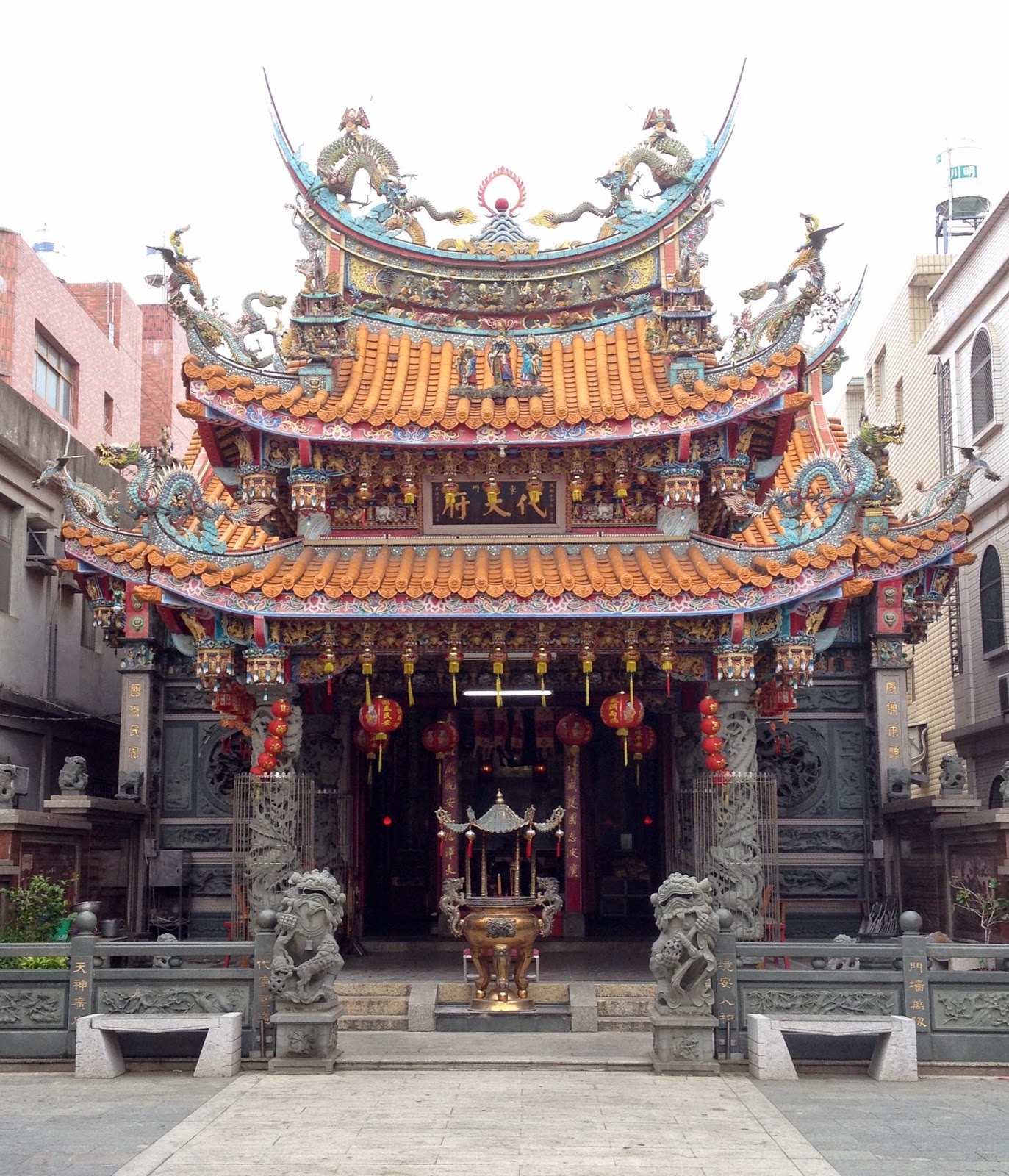
Incense coils burn at a Macanese temple
With the tables clearly not going our way, we decided lunch was in order and hopped in a cab over to Old Town, a section of Macau yet un-Vegasized, with plenty of old Portuguese influence. We looked up a hole in the wall cafe on the internet with good reviews and had a delicious lunch. Afterwards we wandered aimlessly around Old Town, finding an incredible temple in the process, one of the three largest in Macau. We spent about an hour there before deciding it was time to get back to the ferry. We walked "kinda that way" until we managed to find our way back to the central strip of Macau and the ferry port. Returning to Hong Kong, we snagged some delicious pad thai from Thai on High and capped off the night at the apartment. A great end to a meandering and satisfying day.
Incense burns at a Macanese temple
Anna near the ferry terminal in Macau


From Anna:

Nan Lian Gardens
Since this was my first trip to Asia, I decided to come into Hong Kong with only a small amount of expectations. I wasn't sure if I would be walking onto a different planet, or a place where I could still find similarities despite enormous differences. I found both. Hong Kong provided plenty of differences to be a foreign city, but enough familiar moments for it to be comfortable even when we found ourselves lost (again). It is absolutely a city. The amount of people crammed into this small island is absurd. High rise apartments are practically the only apartments around, and people are even buried in a sort of tiered cemetery system. It's as busy as New York, as hilly as San Francisco, and probably has the population of both combined, times two. The language barrier was less of a problem than imagined, as most Hong Kongers speak at least the basics of English. I'm usually someone who likes to get some basics down for the language I'd about to be immersed in, but Cantonese is a completely different animal than the romance languages I've been so exposed to. Something that struck me from the very first day were the temples and shrines that were about as plentiful as Starbucks in New York. Whether completely overwhelming like the temples at the Chi Lin Nunnery, Ngong Ping or Ten Thousand Buddhas, or the little unassuming shrines that dotted street corners and hid under staircases in the city - there was always a peacefulness to them, as if kneeling or sitting in 

Incense sticks burn at Po Lin Monastery
front of them could wipe out the noise and chaos of the city and tourists and put you in a more reflective state. There was also plenty of incense that accompanied the temples and shrines, which made me miss burning it myself. Karl and I both ended up picking up a pack of the standard incense being burned at all the temples we had been to. The smell is rich and incredibly calming (at least for me). 

Food was, of course, the major highlight for us. Americanized versions of foreign regional cuisine is a huge pet peeve of mine, and I relished the idea of having Asian cuisine so close to its roots. Chinese food, in and of itself, is not something I've ever really had a zeal for (unlike some of my college friends), but I was most looking forward to dim sum, since dumplings are absolutely one of my top favorite foods. Tim Ho Wan, a Michelin star rated dim sum place (with unbelievably cheap prices) was literally our first meal here, and it did not disappoint. One of the things I really loved about Hong Kong was the incredible variety of good regional cuisines you could find. Aside from sushi and dim sum and the like, we found an amazing French cafe in Stanley, some good Vietnamese on the Peak, excellent Indian in Central, Japanese ramen that did NOT come from a cup or plastic bag,  simple Portuguese in Macau (appropriately), and pad thai, another one of my all time favorites. We actually got take out from a Thai place down the road and brought it back while Carolyn was out at a business dinner. Obviously, some of the best pad thai I've ever had. We also managed to snag high tea at a restaurant on the top floor of a very tall building with very very very fancy food and very very very fancy bathrooms (and a very, very, VERY nice wine cellar, though that was regretfully not explored). 
Ramen at Ippudo
Vietnamese chicken salad

Something I personally found interesting was the extreme interest in luxury the Chinese culture
Inspecting Banyan Trees
on
 the Peak Circle Walk
seems to have. There are a LOT of extremely nice cars here. We saw a handful of both Ferrari and Lamborghini, as well as numerous Bentleys, Rolls Royces, a couple of Maserati, Porsches... you get 
the idea. If it wasn't a car that would put you in debt, it was a reasonably standard Toyota or Hyundai that had been completely reworked with after-market paint jobs, spoilers, and body kits. Karl and I both remarked at how utterly unnecessary things like the spoilers were, as well as how useless a car like a Lambo or Ferrari would be in a city environment such as this one. They are purely symbols. All this heavy emphasis on the expensive is also reflected in the sheer amount of high fashion designer stores there are in the area, as well as on other islands like Macau. Keep in mind, I'm talking about the same city where Karl and I both bought some lovely knockoff Ray Bans (affectionately dubbed "Faux Bans") for roughly $6.50, and passed by numerous stalls hawking knockoffs of all kinds - from Rolex (Fauxlex) to Abercrombie flip flops. An amusing juxtaposition. Selfie sticks (yes) were as common as pigeons, and taking selfies was a top priority for any Asian tourist. We admittedly had some fun ridiculing the practice.
Most of all, I am just absolutely and totally grateful for my lovely Aunt for hosting us and both showing us around, and sending us off on our own to fend for ourselves. THANK YOU THANK YOU THANK YOU for our wonderful vacation.