Friday, May 8, 2015

A Tale of Two Chinas

Jhushan Village on Kinmen Island, Taiwan dates to 1345 is arranged according to feng shui
As we progress through our second year in Hong Kong, Jeff and I have started giving more thought to our "bucket list" of destinations in Asia to visit before our time here is over.  Two of those destinations are Japan and Taiwan.  While Jeff had been to both for business, he never had time to do any sightseeing, and I had never visited either country. So in April we took a week off and spent a few days in each country.
 
Jeff stands in the entrance of home-stay inn in Jhushan Village


Kinmen's network of civil defense tunnels
offered protection during Communist shelling
Americans typically don't give much thought to the stability and status of our government, so it's hard to imagine what it must be like to be a citizen of a country that is unrecognized by much of the World. The Republic of China (ROC) was established in what is now the People's Republic of China (PRC) in 1912, following the end of the Qing Dynasty. At that time, Taiwan was known as Formosa and was ruled by Japan.  Following World War II, Taiwan and surrounding islands were returned to the Allied Forces and the ROC.  The Nationalist Party, led by Chiang Kai-shek, controlled the ROC, but had a longstanding conflict with the Communist Party.   The two parties joined forces during World War II to resist the Japanese, only to resume their civil war in 1946.  Upon defeat by the Communist Party in 1949, the Nationalist Party government retreated to Taipei and established that city as a provisional capital.  Chiang resumed his role as President and maintained his intention to retake the Mainland until his death in 1975.  For its part, the Communist Party established the People's Republic of China on October 1, 1949 and still actively claims Taiwan as part of its territory to this day.  Until 1971, the ROC was recognized as the sole legitimate government of China by the UN and most Western countries.  However, UN recognition of the PRC in 1971 triggered the ROC's ultimate expulsion from the UN.  Since that time, the "One China" policy has resulted in the reduction of countries recognizing the ROC from 71 in 1969 to just 22 in 2013, while recognition of the PRC has grown from 48 to 172 countries over the same period. 

The Jugang Tower was built as a memorial to the fallen soldiers of Kinmen 

When ROC forces retreated to Taiwan island, they retained control over two islands in the Taiwan Straits: Quemoy (or Kinmen) and Matsu.  Control of these islands, which are located much closer to the coast of the PRC than to Taiwan, proved to be of both strategic and political importance in the standoff.   Quemoy sits less than two miles from the PRC coast and was first shelled by the Communists in 1954.  The U.S., which viewed ROC control over Quemoy and Matsu as critical in containing the spread of Communism in Asia, responded by threatening the use of nuclear weapons against the Mainland.   A second round of shelling by the Communists in 1958 led to another crisis, during which the U.S. military's supply of weapons simply outlasted the Communists'.  Following this, the two sides continued to shell each other until 1979, with leaflets and propaganda replacing explosives in many of the shells. 

Chen Ching Lan Mansion is an example of western architecture on Kinmen

After years as a military reserve under martial law, administration of Quemoy was transferred from military to civilian government in the 1990s.  And as tensions between the ROC and PRC waned, Quemoy eventually became a tourist destination, with direct travel between the island and the Mainland beginning in 2001.
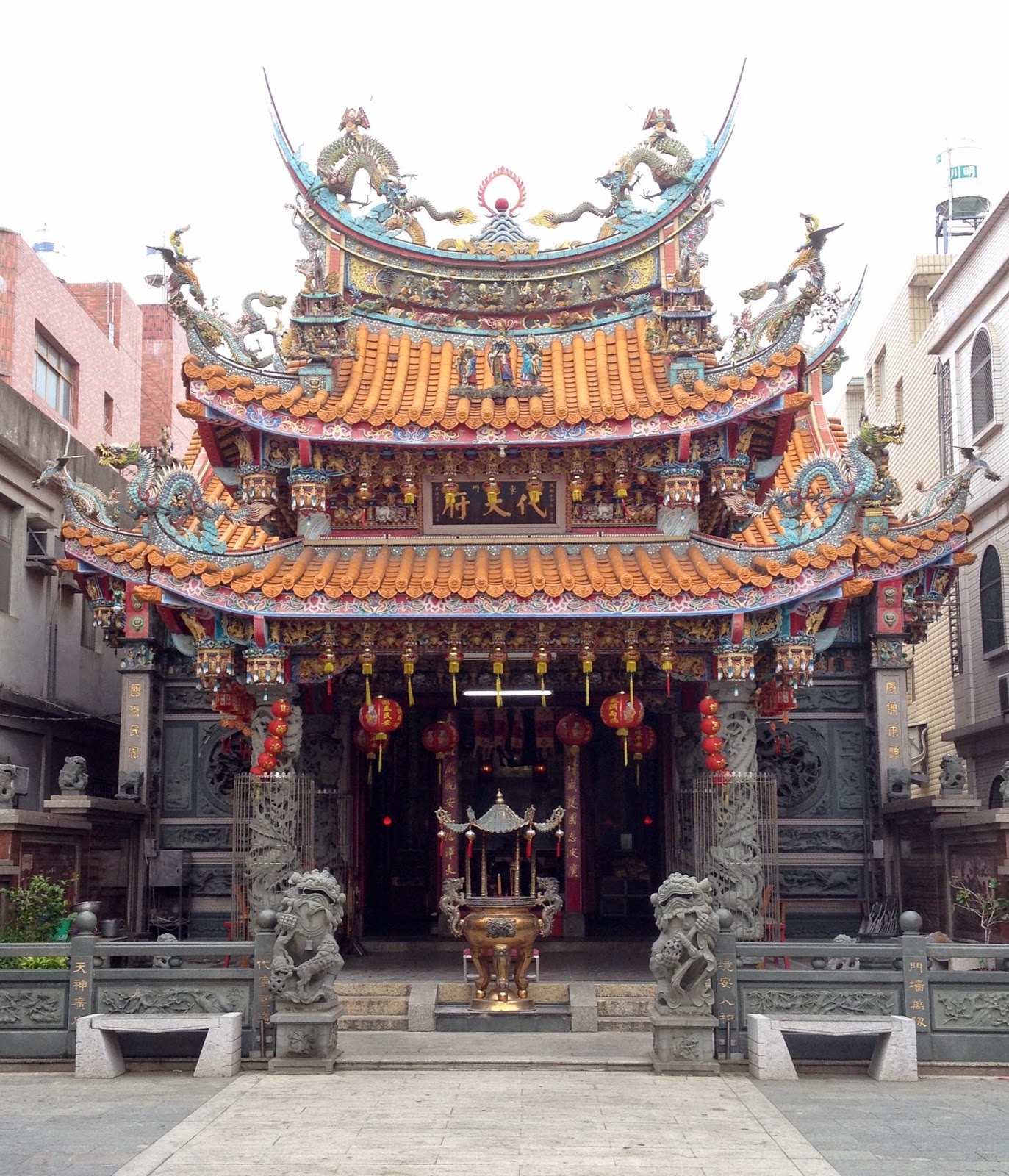
One of the many elaborate temples on Kinmen
Jeff and I traveled to Quemoy on a one hour flight from Taipei.  And although the island's military history is still evident, it does not interfere with its lush, green beauty or the kindness of the 130,000 people who call it home.  The economy is supported primarily by tourism, followed by the production of Kaoliang or sorghum wine, agriculture and fishing.  The surplus of steel left over from the years of shelling gave rise to "bombshell cutlery."  The Maestro Wu steel knife factory got its start making knives from bombshells dropped by the Allies during World War II when Taiwan was occupied by the Japanese.  Today the company uses remnants from the Communist shelling as its main supply of steel for its knives.  Jeff and I visited the factory, saw a demonstration of how the knives are made and did a little shopping.  Maestro Wu estimates that the bomb shells left over from the Communist shelling will supply steel for making knives for another sixty years! 

Steel bomb shells are raw materials at the Maestro Wu steel knife factory

During our visit to Quemoy, we found the island to be very tourist-friendly.  Bicycles are free of charge for up to three days, and we used them to cycle around most of the island. In addition to the knife factory, we visited temples, beaches and the civil defense tunnels villagers used during the Communist shelling.  Quemoy villages are considered to be some of the best examples of traditional, clan-style dwellings in Taiwan.  There is an extensive network of "home stay" inns, and we stayed in one in Jhushan, a 14th Century village known for its houses with elegant swallow-tail roofs arranged according to feng shui.

Now that we have been in Hong Kong for just a little more than one year, we have learned that there are numerous cultures and histories that make up China.  While Taiwan is the China at the center of 20th Century political and military history and the line past which Communism did not spread, it goes without official recognition by most of the rest of the world.  Our trip to Quemoy gave us the opportunity to see up close where much of this history took place.

Saturday, May 2, 2015

Nepal Update

Jeff and I had the privilege of visiting Nepal in February, so we are closely following the developments there following last weekend's massive earthquake.  There are just no words to adequately describe the tragic loss of so many lives and the destruction of so many historic and unique buildings and monuments.  But we are happy to report that our friends who live in Kathmandu are safe.

During our visit to Nepal, we met Satish Kharel (9N1AA), Nepal's first native licensed amateur radio operator and his daughter Tejaswita (9N1DX), currently Nepal's youngest amateur.  We have heard from both of them by email.  Satish and his family are safe, and their house is intact.  Following natural disasters, amateur radio operators frequently step up to provide the critical communications needed to support rescue operations.  Satish has been very active since the quake and was featured in an interview on The Weather Channel.  (Stash's interviews starts about 1:45 into the video.)

We have also heard from Father Greg Sharkey, a Culver Military Academy classmate of Jeff's and a Jesuit who has lived in Nepal for more than thirty years.  The Jesuits have a well-established rural mobile health program in Nepal, and they are leveraging that program, along with their partner organizations, to deliver relief in remote villages.   The Midwest Jesuits have established a fund to support the relief efforts, and all of the funds are used directly to provide goods and services in person-to-person operations run by Jesuits.  If you are considering a donation to support the earthquake relief efforts in Nepal, this is a good option.  With their many years of experience in Nepal, the Jesuits will use the funds very efficiently and maximize their impact, no matter how large or small the contribution.  Donations can be made at this website.

Our blog post from our trip in February can be found here.  The video below is from our trip to Nepal in February and contains photos of the beautiful places we saw and the very kind people we met.


Sunday, April 12, 2015

It's Chau Time!

Tung Ping Chau sits in far northeastern Hong Kong
The fact that neither Jeff nor I speak Cantonese is rarely a major issue for us here in Hong Kong.  English is actually an official language here, and the sheer number of foreigners living here means that most signage, documents, websites and other sources of information are usually available in English.  Even the locals that don't speak English seem to have ways of communicating that enables them to address just about any situation that might arise.  In our day to day lives, we constantly read Chinese words that are written in English characters, and we frequently don't take the time to understand the meaning of them. 
Tung Ping Chau is one of Hong Kong's eight Geoparks
Hiking trails circumnavigate the island

But every once in awhile, the proverbial light bulb goes off and the meaning of one of those words suddenly becomes obvious to us.  Recently, that happened with the word "chau."  We suddenly noticed that many of the more than 200 islands that make up Hong Kong have the word "chau" in their names, so we concluded that "chau" must mean "island" in Cantonese.  When I asked a colleague at work if that was correct, she confirmed that it is, but added that it's actually pronounced "tsau," with more of a "t" sound at the beginning, not with the "ch" sound as the word is spelled in English.  She also volunteered that Chinese speakers are frequently confused by the English spelling of Chinese words as they often are different than the Cantonese pronunciation.

The meaning of the word "chau" became obvious to us because we enjoy exploring Hong Kong's
various outlying islands during our free time on the weekends.  Frequent and inexpensive ferry services between the islands provide an easy way to get away from chaotic Central Hong Kong and enjoy the peace and quiet offered by the less-crowded and automobile-free islands.
Sedimentary rocks line Tung Ping Chau's coastline

Many of these islands are a just a short ferry ride from Central and have at least a small population of permanent residents.  But one island was particularly intriguing to us due to its remote location and interesting history.
Hiking trails run through a bamboo jungle in the center of the island
Tung Ping Chau sits in far northeastern Hong Kong.   Just 2.5 miles from the coast of the Guangdong Province, the island is actually closer to Mainland China than the rest of Hong Kong.  At less than half a square mile in size, it's a fairly small island, and a seasoned hiker can circumnavigate its coastline in about four hours.
Abandoned buildings are scattered across Tung Ping Chau
Once a thriving fishing community of about 3,000 people, Tung Ping Chau now has less than a dozen permanent residents that survive with the assistance of generators and improvised water pumping stations.  Our plans to visit on a couple of earlier occasions didn't work out, and we became determined to get there before the hot weather of summer arrives.  So yesterday, we set out in the rain for our day on Tung Ping Chau.
The Tin Hau Temple on Tung Ping Chau
The island's proximity to Mainland China contributes to its colorful history.  During the Japanese occupation of Hong Kong (1941-1945), Tung Ping Chau was used as a logistics base to supply the Chinese army.   A period followed in the 1950s and 1960s when smugglers used the island for trading in opium and illegal guns.  During the Cultural Revolution (1966-1976) some mainlanders braved the shark-infested waters, swimming to Tung Ping Chau in hopes of seeking asylum in Hong Kong.  A camp, now abandoned, for British military Gurkhas was built on the island in 1975, before discussions of the handover had begun.  
Despite few residents, offerings were left at the Tin Hau Temple
Tung Ping Chau is one of Hong
Kong's five marine parks
Today, the Hong Kong police maintain a presence there, occasionally checking IDs to prevent anyone from using the island to enter Hong Kong illegally.  At its peak, Tung Ping Chau had multiple villages, temples and a couple of schools, but trade with the mainland, the island's economic lifeblood, declined during the 1950s and 1960s as a result of the Korean conflict and the Cultural Revolution.  At that point, Tung Ping Chau's population began to move away.

Today, Tung Ping Chau is primarily a recreational destination, with hiking, camping and snorkeling or SCUBA diving the main draws.  Marine research is also conducted in the relatively pristine waters surrounding the island. The island's land mass is made up of ancient sedimentary rock, which is unique for Hong Kong, giving the island its spectacular coastline and beautiful beaches.  Tung Ping Chau is one of eight parks that make up the Hong Kong Global Geopark, and the island is located in one of Hong Kong's five designated Marine Parks and Marine Reserves.    

Jeff poses with the crew of one of Tung Ping Chau's "pop-up" restaurants
We spent our day on Tung Ping Chau hiking the trails through the jungle, examining the abandoned buildings and taking in the views along the coastline.  Because of the steady stream of weekend visitors, there are a few "pop-up" restaurants, so we stopped at one for some fried rice and sea food at lunch.  Ferry service to Tung Ping Chau is from Ma Liu Shui in the New Territories and the journey takes about one hour and forty minutes.  Because the island is so remote, ferries run on weekends only, and there is only one departure, at 5:15pm, to the New Territories each day.  Miss the ferry on Saturday, and you will spend the night on the island; miss it on Sunday, and you will spend the next week there!  Due to the rainy weather, we enjoyed a day where we almost had the entire island to ourselves.  But by 5:00, we were ready to go home and dry off, so we made sure we were at the pier when our ferry departed Tung Ping Chau.

Friday, March 27, 2015

Spring Break in Hong Kong

My nephew and niece Karl and Anna
This is another guest post, this time written by my nephew and niece, Karl and Anna Maher. Karl is a senior at Northwestern University, majoring in Film.  Anna, a Vocal Performance graduate of James Madison University, is a singer and model living in Orono, MN. Although both have traveled abroad, neither of them had been to Asia before, so they chose to spend their spring break visiting us in Hong Kong.  We had a busy and fun week together, and although their flight left just a few hours ago, we miss them already.  This blog post was written by them and contains their photos from their week in Hong Kong.

From Karl:
The Ventian Hotel & Casino in Macau

Macau: On Thursday after a leisurely start to the morning, Anna and I walked down to the Macau/HK ferry terminal and made the trip across the water to the gambling paradise of China. At the urging of a mysterious looking David Beckham, we opted to take the free shuttle to The Venetian casino, and arrived at an outrageously overdecorated hotel in Taipa, a southern island of Macau. After meandering about the casino floor for a while, I opted to try my luck at roulette, bet twice on black, and lost my $20HK (about $2.50). To be fair, a fortune teller from the other night did say I shouldn't gamble, so I guess I was asking for it.  
Incense coils burn at a Macanese temple
With the tables clearly not going our way, we decided lunch was in order and hopped in a cab over to Old Town, a section of Macau yet un-Vegasized, with plenty of old Portuguese influence. We looked up a hole in the wall cafe on the internet with good reviews and had a delicious lunch. Afterwards we wandered aimlessly around Old Town, finding an incredible temple in the process, one of the three largest in Macau. We spent about an hour there before deciding it was time to get back to the ferry. We walked "kinda that way" until we managed to find our way back to the central strip of Macau and the ferry port. Returning to Hong Kong, we snagged some delicious pad thai from Thai on High and capped off the night at the apartment. A great end to a meandering and satisfying day.
Incense burns at a Macanese temple
Anna near the ferry terminal in Macau


From Anna:

Nan Lian Gardens
Since this was my first trip to Asia, I decided to come into Hong Kong with only a small amount of expectations. I wasn't sure if I would be walking onto a different planet, or a place where I could still find similarities despite enormous differences. I found both. Hong Kong provided plenty of differences to be a foreign city, but enough familiar moments for it to be comfortable even when we found ourselves lost (again). It is absolutely a city. The amount of people crammed into this small island is absurd. High rise apartments are practically the only apartments around, and people are even buried in a sort of tiered cemetery system. It's as busy as New York, as hilly as San Francisco, and probably has the population of both combined, times two. The language barrier was less of a problem than imagined, as most Hong Kongers speak at least the basics of English. I'm usually someone who likes to get some basics down for the language I'd about to be immersed in, but Cantonese is a completely different animal than the romance languages I've been so exposed to. Something that struck me from the very first day were the temples and shrines that were about as plentiful as Starbucks in New York. Whether completely overwhelming like the temples at the Chi Lin Nunnery, Ngong Ping or Ten Thousand Buddhas, or the little unassuming shrines that dotted street corners and hid under staircases in the city - there was always a peacefulness to them, as if kneeling or sitting in 

Incense sticks burn at Po Lin Monastery
front of them could wipe out the noise and chaos of the city and tourists and put you in a more reflective state. There was also plenty of incense that accompanied the temples and shrines, which made me miss burning it myself. Karl and I both ended up picking up a pack of the standard incense being burned at all the temples we had been to. The smell is rich and incredibly calming (at least for me). 

Food was, of course, the major highlight for us. Americanized versions of foreign regional cuisine is a huge pet peeve of mine, and I relished the idea of having Asian cuisine so close to its roots. Chinese food, in and of itself, is not something I've ever really had a zeal for (unlike some of my college friends), but I was most looking forward to dim sum, since dumplings are absolutely one of my top favorite foods. Tim Ho Wan, a Michelin star rated dim sum place (with unbelievably cheap prices) was literally our first meal here, and it did not disappoint. One of the things I really loved about Hong Kong was the incredible variety of good regional cuisines you could find. Aside from sushi and dim sum and the like, we found an amazing French cafe in Stanley, some good Vietnamese on the Peak, excellent Indian in Central, Japanese ramen that did NOT come from a cup or plastic bag,  simple Portuguese in Macau (appropriately), and pad thai, another one of my all time favorites. We actually got take out from a Thai place down the road and brought it back while Carolyn was out at a business dinner. Obviously, some of the best pad thai I've ever had. We also managed to snag high tea at a restaurant on the top floor of a very tall building with very very very fancy food and very very very fancy bathrooms (and a very, very, VERY nice wine cellar, though that was regretfully not explored). 
Ramen at Ippudo
Vietnamese chicken salad

Something I personally found interesting was the extreme interest in luxury the Chinese culture
Inspecting Banyan Trees
on
 the Peak Circle Walk
seems to have. There are a LOT of extremely nice cars here. We saw a handful of both Ferrari and Lamborghini, as well as numerous Bentleys, Rolls Royces, a couple of Maserati, Porsches... you get 
the idea. If it wasn't a car that would put you in debt, it was a reasonably standard Toyota or Hyundai that had been completely reworked with after-market paint jobs, spoilers, and body kits. Karl and I both remarked at how utterly unnecessary things like the spoilers were, as well as how useless a car like a Lambo or Ferrari would be in a city environment such as this one. They are purely symbols. All this heavy emphasis on the expensive is also reflected in the sheer amount of high fashion designer stores there are in the area, as well as on other islands like Macau. Keep in mind, I'm talking about the same city where Karl and I both bought some lovely knockoff Ray Bans (affectionately dubbed "Faux Bans") for roughly $6.50, and passed by numerous stalls hawking knockoffs of all kinds - from Rolex (Fauxlex) to Abercrombie flip flops. An amusing juxtaposition. Selfie sticks (yes) were as common as pigeons, and taking selfies was a top priority for any Asian tourist. We admittedly had some fun ridiculing the practice.
Most of all, I am just absolutely and totally grateful for my lovely Aunt for hosting us and both showing us around, and sending us off on our own to fend for ourselves. THANK YOU THANK YOU THANK YOU for our wonderful vacation. 


Saturday, March 7, 2015

A City Within a City Within a City

The Kowloon Walled City Park is in Kowloon City District
When we moved to Hong Kong last year, I had only visited once, and Jeff had never been here before. Our mental images of the city had been shaped in part by famous photos of airplanes flying precariously low as they made a last-minute ninety degree turn over tall apartment buildings on the final approach into Hong Kong's old Kai Tak Airport, located on the Kowloon Peninsula. Although we knew that Kai Tak had been retired and replaced with a new airport on safer ground on Chek Lap Kok Island in 1998, we did not know the colorful and rich history of one of the neighborhoods under the old flight path: the Kowloon Walled City.
The Mountain View Pavilion in the Kowloon Walled City Park
Now a city park, the Walled City sits in what is now the Kowloon City District of Hong Kong, making it a kind of city within a city, within yet another city.  The irony of  describing it that way is that for a period of many years, neither the British nor the Chinese asserted any real jurisdiction over the Walled City.  Established as an imperial fort under the Song Dynasty (10th to 13th century), its original purpose is believed to have been to monitor salt trade.  When Hong Kong Island came under British control in 1842, the Walled City gained new significance when the Qing Dynasty expanded it, adding a defensive wall to strengthen its position against the British.  After the British and Chinese entered into a 99-year lease over Kowloon and the New Territories in 1898, the location of the Walled City fell within British territory, but the lease contained a clause permitting the Chinese to maintain a military presence.  That arrangement lasted only one year, until the British invaded the Walled City and expelled the Chinese resident officer for inciting rebellion against them.  From that point forward, the Walled City fell into a kind of sovereign no man's land.  The British revoked the clause in the lease, asserting their right to control the city, while the Chinese continued to maintain that the Walled City was Chinese territory.  In reality, neither government asserted much influence there for the next forty-five years.  
Jeff inspects the foundation of the South Gate, one
of only a few preserved relics of the Walled City
During World War II, the occupying Japanese forces destroyed the city's wall, using the stone remnants as fill for expanding Kai Tak Airport.  Following the Japanese surrender, the Chinese re-asserted their right to control the Walled City, and its population swelled as refugees poured in, seeking the protection offered by the Chinese government.  With the Walled City rapidly becoming a slum, the British attempted to clear it in 1948, but failed when residents objected on the basis that it was Chinese territory.  The neighborhood then fell under the spell of organized crime  (known as Triads) and became notorious for its dens of iniquity. Remarkably, it also became known for its close-knit sense of community among families and neighbors who maintained tight bonds and helped one another out in the cramped quarters.  Basic services like water and sanitation were limited.  Many families hauled water in buckets from one of only a few fresh water standpipes in the neighborhood. There were reports of children suffering from rickets due to a lack of sunlight. Although the city provided mail service, the couriers assigned to that route had to post makeshift house numbers on the dwellings just to make deliveries. 


A Moon Gate makes a peaceful passageway
inside the Kowloon Walled City Park
By the late 1980s, with 33,000 people living in 500 buildings across its 6.9 acres, the Walled City was considered the most densely populated place on Earth. Building heights were capped at fourteen stories due to its location under the Kai Tak Airport approach, and a concerted effort by the Hong Kong Government had reduced crime and the influence of the Triads.  In 1987, shortly after Britain and China signed the Joint Declaration which outlined the terms for the return of Hong Kong to Chinese rule in 1997, the two governments finally agreed that the Walled City fell under British control, and the decision was made to demolish it.  A total of US$350 million was distributed to the residents and businesses as compensation; demolition began in March 1993, finishing a little more than one year later.  Construction of the existing Kowloon Walled City Park began right away, and the park was dedicated by the final British Governor of Hong Kong in December 1995.  Produced to mark the 20th anniversary of the demolition, this Wall Street Journal retrospective provides fascinating perspective on the population density and life in the Walled City.

Many of us could not imagine living in the kind of conditions that existed in the Kowloon Walled City. For us, a measure of privacy, running water and basic sanitation are a way of life. But it is fascinating to learn how a strong sense of community developed and thrived among the people who lived there, even making many of them reluctant to leave when the days of the Walled City came to an end. 
A Bronze replica and cross section of the buildings etched
in glass provide insight on life inside the Walled City
 

Saturday, February 28, 2015

Three Busy Days in Nepal

Prayer flags flutter in the wind at Boudhanath Stupa in Boudha, Nepal
As the two most populous and fastest growing countries, China and India warrant a lot of attention from the rest of the world, but that sometimes means there are interesting places being overlooked right next door.  Nestled between the Tibet Autonomous Region of China to the north and India to the south sits Nepal, a country that is home to the Himalayas, the birthplace of the Buddha, an evolving community of amateur radio operators and one of Jeff's classmates from Culver Military Academy.  Yes, you read that correctly; we just happen to know someone who lives in Kathmandu.

With a flight time of just four hours from Hong Kong, a trip to Kathmandu, Nepal seemed like a good way to spend our extended Chinese New Year weekend.  Best known for trekking expeditions and Mount Everest, Nepal has so much more to offer, including ten UNESCO World Heritage Sites, most of which are in the Kathmandu Valley.  Jeff and I had the opportunity to visit a few of these sites but the real highlight of our trip was visiting with some fellow Hams (amateur radio operators) and fellow Culver alum Greg Sharkey.
A Culver reunion takes place far from Indiana
Jeff graduated from Culver with Greg Sharkey, an American Jesuit and Professor at Rangjung Yeshe Institute at Kathmandu University where he teaches courses on Hinduism, Newar Buddhism, Nepalese Culture and Comparative Theology.  After more than thirty years in Nepal, Greg has built an active life filled with students, academic pursuits and many Nepali friends.  One of Greg's friends, Bhoj, is a driver who graciously agreed to take us around to see some of the sites in the city.  Bhoj demonstrated that he is an expert at navigating the chaotic Kathmandu traffic clogging the streets and fouling the air.
The temple at Hanuman Dhoka Durbar
Prayer wheels at Swayambhunath Stupa
Our sightseeing started in the Old City with a visit to Durbar Square. The term "Durbar Square" is used frequently to describe the plaza in front of a royal palace, and typically these sites contain temples, statuary or religious icons, monuments and/or fountains.  In Kathmandu, Durbar Square contains over fifty temples and monuments and includes Hanuman Dhoka Durbar (the Hanuman Royal Palace).  Just outside the gates of the palace is a statue of Hanuman, the Hindu God who is depicted as a monkey.  Construction of the palace, which began in the 16th century,
Swayambhunath Stupa
features intricate woodcarvings, fourteen courtyards and a temple with five round roofs dedicated to the five-faced deity Pancha Mukhi Hanuman.  The Basantapur Tower, which was added in the 18th Century, is nine stories high, and we made the climb to take advantage of the sweeping vistas over the Kathmandu Valley.

"Stupa" is a Sanskrit word for a mound-shaped structure containing either Buddhist relics or the ashes of Buddhist monks.  Early in the morning we visited the Swayambhunath Stupa or the "monkey temple" as it is commonly known for the creatures that live throughout its grounds.  Swayambhunath is a massive site, sitting high atop a hill climbed by pilgrims each day for the privilege of engaging in their daily worship by circumnavigating the stupa, usually clockwise, while spinning the banks of prayer wheels as they walk.
Pashupatinath Temple is open only to Hindu worshipers

Considered to be one of the most sacred of Newar Buddhist sites, Hindus also worship at Swayambhunath, and although there are other stupas, it is one of the oldest religious sites in Nepal, dating to the 5th Century.
Smoke rises from funeral pyres along the Bagmati River
We were also able to visit the Boudhanath Stupa, which dates to the 14th Century and is the most sacred site in Nepal for Tibetan Buddhists. Boudhanath is located in Boudha, a town on the east side of Kathmandu, and unlike Swayambhunath, which sits atop a hill, Boudhanath's massive structure is nestled in an urban square, surrounded by buildings containing  restaurants, guest houses and shops selling tourists trinkets. The location does not prevent the faithful from performing the ritual walk around the stupa.

Our last stop was at Pashupatinath Temple complex, a sacred Hindu site on the Bagmati River.  The Hindu temple is named for Pashupatinath or Lord of the Animals, a form taken by Shiva, one of the primary forms of God in Hinduism.  The complex is made up of more than two hundred temples and shrines that straddle the river.
Sadhus at Pashupatinath Temple Complex

On the banks of the river are cremation ghats or platforms, where funeral pyres billow smoke and ashes are scattered into the sacred Bagmati, which eventually flows into the holy Ganges river.   Pashuptinath receives hundreds of thousands of pilgrims each year, but only Hindus are allowed inside the temple itself.   We wandered the grounds, taking in the sites and encountering various Sadhu, Indian holy men who have renounced worldly possessions and lead a life in search of enlightenment, although it wasn't easy to tell which of them were real and which were dressed up for the tourists.

Jeff and Satish inspect his antennas

During our time in Kathmandu, we had the privilege of meeting up with Nepal's first native licensed amateur radio operator, Satish (9N1AA) and his daughter Tejaswita (9N1DX), currently Nepal's youngest amateur.  Satish hosted us to an exquisite lunch before giving us a tour of his ham shack and introducing us to his family, which comprises 60% of the amateurs licensed to use high-frequency bands in Nepal.

For our last night in Nepal, we accompanied Greg to Lamatar Lodge in the mountains above the town of Lubhu, southeast of Kathmandu.  The lodge is owned by Greg's friend Dinesh, who plans to open it to trekkers and tourists.  We enjoyed the warm hospitality of Dinesh and his family in a peaceful, wooded location in the mountains, along with delicious meals prepared by Chandra and Raju.


Three days in Nepal was not enough time to enjoy everything it has to offer.  Even our new Nepali friends told us that we need to return and "stay longer next time."  But our visit gave us the opportunity to reconnect with a friend, make new friends and plan for a longer stay next time.
We received a warm welcome at Lamatar Lodge

Sunday, February 15, 2015

When One is Not Enough: 10,000 Statues of Buddha

The Ten Thousand Buddhas Hall is the  main attraction at the Monastery
One of the advantages of living in Hong Kong is the fact that we get two New Year's celebrations:  a "western" New Year on January 1, and a Lunar or Chinese New Year that follows (for what we learned about Chinese New Year, see last year's blog post called Kung Hei Fat Choi).  A second New Year provides another shot at New Year's resolutions, in case the first round didn't quite go as planned.  Following our return from the States last month, we fell into a bit of a post-holiday slump and our blog was one of the casualties.  But the approaching Chinese New Year gives us another shot at getting back on track, and the place we ventured to yesterday was a really nice motivation.  

The steep path to the Monastery involves over
430 steps lined by 500 life-sized gilded statues
The Ten Thousand Buddhas Monastery (10kbuddhas.org - in Chinese only) is in Shatin Pai Tau village, located about eleven miles north of  Central Hong Kong in the New Territories.  Although the monastery is not residential, it is one of Hong Kong's most famous Buddhist temples.  For Jeff and me, getting there involved a one hour MTR (subway) trip with two changes of trains.  The most daunting part of the journey was the 431 steps that lead from the base of the hill up to the Monastery.  The stairs are lined with over five hundred gilded life-sized Arhan statues, each with different expressions, poses and dress.  In Buddhism, an Arhan is one who is considered worthy or who is relatively advanced along the path of enlightenment, but still short of achieving Buddhahood.    The long climb is rewarded at the top with a colorful and ornate complex of five temples, four pavilions, a nine story pagoda, a veranda with sweeping views of the mountains and Sha Tin District, a small vegetarian restaurant and more Arhan statues.
The pavilion in the center of the lower section of the
Monastery features a statue of the Goddess of Mercy
The pagoda was featured on the HK$100 note
The Monastery was founded in 1949 by Reverend Yuet Kai, a philosophy student born into a wealthy family in southern China who dedicated his life to Buddhism.  During the eight years of construction, Reverend Kai and his followers carried all of the building materials for the Monastery up the steep mountain.  Following his death in 1965, Reverend Kai was buried for eight months, then disinterred by his followers. His remains were considered so intact that they were embalmed with lacquer and gold leaf, adorned in robes, and seated before the altar, where they remain today in a glass case with a sign that reads, "The Diamond Indestructible Body of Yuet Kai."

The Monastery is situated on nearly twenty acres of bamboo forest, but most of the buildings are located in a relatively compact area that is easy to stroll around.  In 1997, heavy rain and landslides damaged some of the buildings, forcing the Monastery to close for 2-/12 years.
Offerings are left on the altar under the
 portico of the Ten Thousand Buddhas Hall

The portico of the Ten Thousand Buddhas Hall
has an altar where offerings are placed 
Four of the five temples are located in an upper section (a further 69 steps) where reconstruction is still ongoing.  On the
lower or main level of the complex is a large terrace with the Ten Thousand Buddhas Hall (the main temple) at one end, the nine story pagoda at the opposite end and a pavilion sheltering a large statue of the Goddess of Mercy in between.  A rogue's gallery of more gilded Arhan statues surrounds the outside of the terrace.

Despite the fascinating structures, the elaborate decoration of the Ten Thousand Buddhas Hall makes it the main attraction.  In front of the Hall, an elaborate burner filled with incense and joss sticks gives off puffs of smoke.  The Hall has an elaborate frieze and beneath it a portico containing an altar, at which many offerings of fruit and flowers had been left.  Inside, in addition to the lacquer-embalmed body of the Yuet Kai, the Hall features over 12,800 Buddha statues lining the walls, each about 12 inches high with a unique pose and facial expression.  The discrepancy between the Monastery's name and the actual number of Buddha statues is explained by Cantonese tradition:  the term "ten thousand" is merely figurative, representing a very large number (much like the term "tens of thousands.")  Regardless of the precise numbers, the sight of so many Buddha statues is overwhelming to say the least.
The walls of the Ten Thousand Buddhas Hall are
lined with nearly 13,000 unique Buddha statues 
It may have taken more than 10,000 Buddhas to get us out of our post-holiday slump, but as we begin our second year in Hong Kong, we realize that yesterday's excursion was a good example of how much remains for us to explore here.
An incense burner sits in front of the Ten Thousand Buddhas Hall