Monday, June 2, 2014

Tuen Ng Festival & Dragon Boat Races

A dragon head at the bow of a dragon boat
Last Monday was a quiet day here: it was Memorial Day in the U.S. and the Spring Bank Holiday in the U.K.  The resulting lack of activity in our inboxes made for a slow day, and we felt like we'd missed out on the traditional start to summer.  This weekend we got our 'start of summer' fix -- a three day weekend with the Tuen Ng or Dragon Boat Festival.

Tuen Ng is a public holiday in Hong Kong, Macau and Taiwan.  Despite its Chinese origins, it wasn't a public holiday in the People's Republic of China until 2008.  It is also celebrated in Chinese communities throughout southeast Asia.  Like a number of other Chinese holidays, the day Tuen Ng is celebrated is based on the lunar calendar, so the day it is recognized on the modern calendar changes each year.  Officially, it is celebrated on the fifth day of the fifth month of the lunar calendar, so in some places it is also referred to as the Double Fifth Festival.  The traditional way of celebrating Tuen Ng is by eating rice treats wrapped in bamboo leaves (called zongzi), drinking a traditional Chinese medicinal wine (called realgar) and by racing Dragon Boats.
A dragon boat team heads out to the starting line
There is some debate about the origin of the holiday, but the most widely accepted version of the story centers around a poet and government official named Qu Yuan who lived between 343 and 278 B.C.  As a minster for the kingdom of Chu, Qu Yuan developed a reputation as an advocate for alliances between various kingdoms in ancient China.  However, rival corrupt functionaries slandered him, causing the King of Chu to send him into exile, where he spent his time writing poetry and falling into a deep depression.  As a means of protesting the corruption as well as the collapse of his kingdom, Qu Yuan committed ritual suicide by drowning himself in the Miluo River in what is now Hunan Province.  Qu Yuan's admirers are said to have tried to save him by racing out into the river in their boats, splashing the water with paddles and beating their drums.  This is said to be the origin of the Dragon Boat races.  When they were not successful at saving him or even finding his body, Qu Yuan's admirers dropped balls of sticky rice into the river so that they fish would eat that instead of Qu Yuan's body.  This is the origin of the zongzi traditionally eaten during Tuen Ng.

A dragon boat team competes for the costume prize
In Hong Kong, the celebrations of  Tuen Ng are centered around Dragon Boat races.  Dragon Boats are long, canoe-shaped boats decorated with Chinese dragon heads and tails and powered entirely by a crew of twenty paddlers.  The crew is completed with a drummer in the bow of the boat and a crew member steering with a rudder at the stern.  The races are held on large and small scales in waterfront communities.  We ventured to the village of  Stanley, on the south side of Hong Kong Island, to see the races there.  The Stanley races are among the largest in Hong Kong, with around two hundred local and international teams, most sponsored by big companies.  We saw primarily sprint races in a variety of classes (men's, women's, mixed teams).  Winning teams are awarded trophies, and there is also a prize for the best team costume.

This was a unique way for us to mark the beginning of summer.  We enjoyed spending a warm and steamy morning seeing a modern-day take on a tradition with ancient roots.  The crowds at the event confirmed that Tuen Ng Festival is one of the most popular of the year.

Saturday, May 24, 2014

Abuzz in the New Territories

When we left Minnesota to come to Hong Kong, we left our two beehives in the capable hands of the University of Minnesota Bee Squad.  Last November we prepared our hives for the arctic Minnesota winter by ensuring they had plenty of stored nectar and pollen, covering them with moisture boards and wax-coated boxes and arranging bales of straw around them to act as a wind break.  The Bee Squad did their first check of our hives in March, and unfortunately, had to report that one of our hives did not survive the winter.  But our other hive was alive, hungry and happy to see them.  Since then we have been getting periodic reports from the Bee Squad about how our hive is doing as spring progresses in Minnesota.  With each report, we realize we miss our bees and the anticipation of heading into summer and the honey season.  Hearing about our bees back home got us wondering about where and how people keep honey bees in Hong Kong.

 
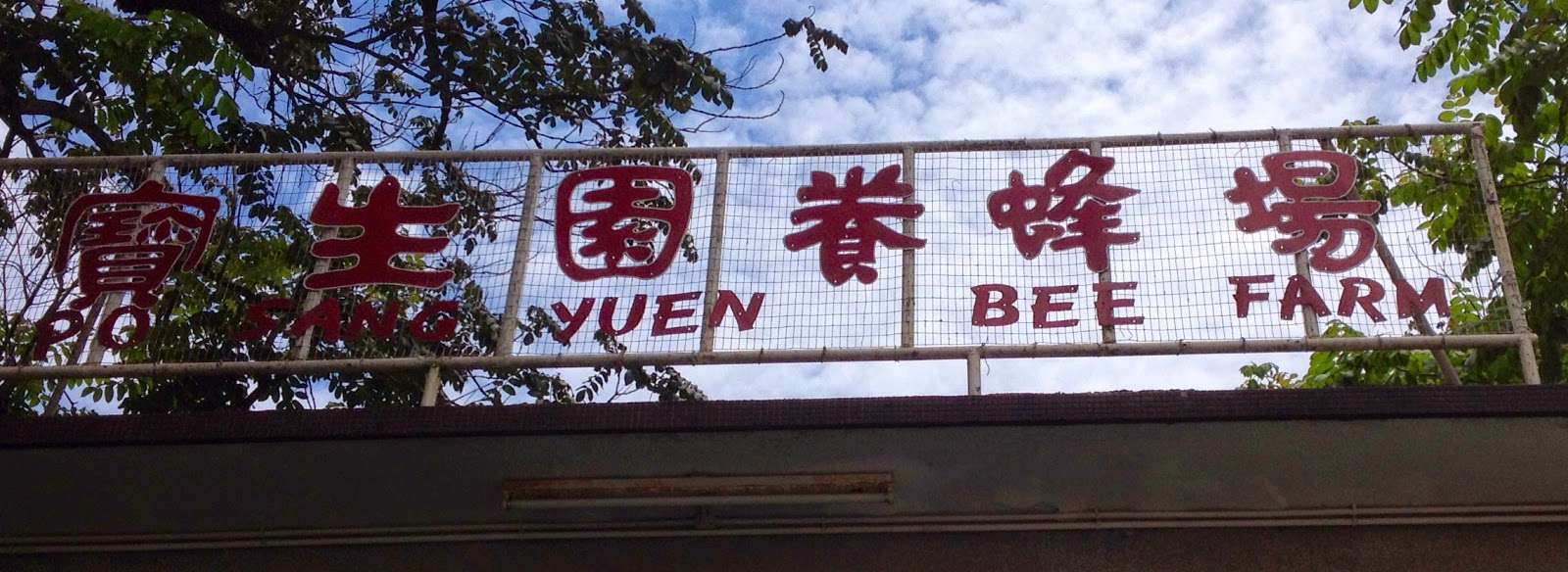
Po Sang Yuen Bee Farm

Edmund Leung at Po Sang Yuen Bee Farm
Asian bees guard a nest in a hollow tree
Although there is growing interest in keeping honey bees in Hong Kong, the hobby is constrained by space limitations throughout the city.  Nevertheless, there are hives scattered about on rooftops and in some green areas.  North of Hong Kong Island is the New Territories, the largest of Hong Kong's three regions.  Space constraints are less of an issue there; the region is home to two bee farms, so we decided to visit one.  The Po Sang Yuen Bee Farm is a short train ride north of Central Hong Kong.  After a five minute walk from the train station, we found it and met Edmund Leung who is the General Manager and grandson of the founder.  Edmund kindly showed us around and told us about his business.  The Bee Farm has over two thousand hives and is in business solely for the production of honey.  Their bees are Asian honey bees or Apis Cerana which are smaller and more docile than the western honey bees (or Apis Mellifera) that we keep in Minnesota.  In addition to their hives in the New Territories, the Bee Farm also has hives scattered around mainland China and in Chiang Mai, Thailand. 
Jars of Buckwheat and Lungan honey
Placing hives in different locations enables Po Sang Yuen Bee Farm to produce different types of honey because the variety of flowers and trees produce different nectars and pollens.  We recognized some of their honey varieties, like Buckwheat, but others, such as Lychee and Lungan were new to us.  Po Sang Yuen Bee Farm harvests comb honey from their hives in the New Territories, while honey is extracted and bottled from their hives in mainland China and Chiang Mai.
Bee hives at Po Sang Yuen Bee Farm

 
The honey season in Hong Kong is very different than what we're used to in Minnesota.  Because of the relatively mild climate, honey can be harvested a few times per year.  But Edmund explained that the biggest harvest is usually in early April.  Hives are just one box deep.  During the nectar flow, only one super is added to each hive to collect excess honey for harvesting, and it is usually on the hive for about three weeks.  Because the climate is so humid in Hong Kong, the nectar would not cure sufficiently to become honey if more supers were stacked on top of the hive.  In Minnesota by comparison, our hives are two or three boxes deep, and we might have four or even more supers on our hives for two months or even longer. 

Inside one of the hives at Po Sang Yuen Bee Farm
Like many bee keepers, Po Sang Yuen Bee Farm has had challenges with their bees.  Last year, they lost a significant number of their hives due to unusually cold and wet weather, a problem shared by other bee keepers in Hong Kong.  When they lose hives, they try to re-build by dividing the surviving hives and re-queening.

We are grateful for the time that Edmund spent with us to tell us about his bees and his business.  We wish him and Po Sang Yuen Bee Farm much luck and good fortune!
Founder of Po Sang Yuen Bee Farm
Poster at Po Sang Yuen Bee Farm


Tuesday, May 6, 2014

A new respect for rice

The rice terraces near Ubud
It's no secret that rice is a staple of the Asian diet.  We've certainly eaten our share of it since we arrived in Hong Kong, but we hadn't thought about where it comes from or how it grows until we visited the rice terraces in Bali.
The rice terraces near Ubud

For our anniversary, Jeff surprised me with a trip to Bali.  Coincidentally, we share our anniversary date (May 6) with a Hong Kong public holiday celebrating the Birth of the Buddha, so we were able to spend a long weekend away while only missing one day at the office.  Neither of us had been to Indonesia before, so I did a little advance research to help us decide where to spend our time. 

A Dutch colony until after World War II, Indonesia is made up of around 17,000 islands (about 1,000 are inhabited), and its population of almost 240 million people is spread across many ethnic groups.
Our driver Gusti

Since corruption is an unfortunate fact of life, the average citizen doesn't always see the full benefit of the country's vast natural resources, such as oil.  The island of Bali sits just south of the equator on the east end of Java.  Most of Bali's population of four million is Hindu, in contrast to the rest of Indonesia, which is primarily Muslim.  Bali's craft industry is highly developed, specializing in textiles and wood and stone carving.  The arts, along with the beaches, draw more tourism to Bali than anywhere else in Indonesia.  Agriculture is the other major component of Bali's economy, serving as the main employer on the island.  The climate and rich, volcanic soil are ideal for growing rice and coffee, the two main crops on the island. 

I was very excited about seeing the rice terraces.  Since much of the southern part of Bali is devoted to resorts and tourism, I knew we would enjoy getting out into the countryside to explore.  Cars are driven on the left in Indonesia, so in deference to our sanity, as well as our marriage, we hired a driver named "Gusti" who expertly
Pura Desa in Batuan
navigated through all conditions imaginable, from city streets teeming with motor scooters, to remote roads too small for two vehicles to pass.

The rice terraces were breathtaking, greener and lusher than we imagined. No photo could ever do them justice. Gusti explained that three crops per year can be produced, although farmers are increasingly practicing crop rotation.  The water used to irrigate the fields comes from springs in the surrounding mountains.  The farmers rely on gravity and a system of pipes, ditches and valves to direct it to the fields.  Rice farming in Bali is almost entirely manual, and it must be exhausting to haul the harvest up to the top of the terraces for drying or sale to the wholesalers.

Gusti also took us to see a Balinese Hindu temple in the village of Batuan, which dates to 1020 A.D.  The temple or "Pura" in Balinese is the center of the community, so nearly every village has at least one. 
Pura Gunung Kawi
Gusti explained that in the Balinese Hindu faith, temples are reserved for ceremonies that  worship the gods.  Therefore "human ceremonies," such as weddings and funerals are conducted elsewhere.  Visitors are asked to don a sarong during visits, and we gladly complied (even Jeff).

Our last stop was another temple - the Pura Guning Kawi or Holy Springs Water Temple, featuring beautiful water gardens.  Once again, we donned our sarongs and walked through the verdant grounds to view the elaborate pools, fountains and statuary. 
A statue at Pura Gunung Kawi
The pools are open to the devoted who come and wash themselves as part of their religious rituals.

Our weekend getaway was a great way to celebrate fourteen years.  In the four months we've been in Hong Kong, we had started to begin to appreciate the breadth and diversity of Asia.  Our time in Bali reinforced that the diversity is even greater than we imagined.   Our visit to the rice terraces has given us a new appreciation for a food often overlooked.  We will never again eat rice without reflecting on the beauty of the rice terraces and the hard work that goes with harvesting them.


Friday, May 2, 2014

No llamas on Lamma

Only 20 minutes by ferry from bustling Central Hong Kong is a casual, laid-back island community with a population of under 10,000.  Lamma Island is Hong Kong's third largest island with a total area of about five square miles and situated to the southwest of Hong Kong island. 

Lamma is a short ferry ride southwest of Hong Kong Island

View of Yung Shue Wan village on Lamma Island

Lamma is a hiker's dream, with marked trails that start in its small villages, wind through its rugged terrain and lead up its mountains to reveal vast views of its beaches, the ocean and other Hong Kong islands.  This automobile-free island attracts a relatively large number of expatriates -- many of whom are artists and musicians -- drawn by Lamma's tranquility and lower cost of living compared to Hong Kong Island.

Taking a breather from our bicycle ride


Jeff and I visited Lamma on a warm Sunday.  One of the things that got our attention almost immediately is the lack of skyscrapers: Lamma limits building height to three stories, except for a lone wind turbine at the top of one of its peaks.  We rented a pair of dilapidated bicycles and rode through Yung Shue Wan village, dodging and weaving around large groups of tourists from mainland China.  We rode (actually we walked) our bicycles up a steep hill to a hilltop pavilion with amazing views in every direction.  At the top of this hill is the Kamikaze Cave where the occupying Japanese forces stored speedboats and launched suicide missions against Allied ships during World War II. The trail took us past Hung Shing Yeh beach, where large families enjoyed picnics and a swim at the beach where a sign in English urged swimmers to stay inside the shark protection net.

Once we recovered from the steep climb, we coasted back down the hill to Yung Shue Wan village and returned our bicycles (damage for 2 hours: the equivalent of about $9 US Dollars).   Our next stop was Tin Hau Temple, one of three so named on the island.  Tin Hau is the goddess of the sea, and she is traditionally honored by fishermen and others whose livelihood depends on the sea.  As such, Tin Hau Temples are typically found in coastal towns throughout China.  Burning coils of incense hang in front of the temple's entrance, and a look through the doorway reveals an elaborate interior.  We were invited to light incense sticks in front of the temple, but discouraged from taking any photos inside.
Incense coils burn in front of Tin Hau Temple
We finished our visit to Lamma with a leisurely stroll through the village, stopping for a seafood lunch and a little shopping before catching the short ferry ride back to Central Hong Kong.

Tuesday, April 22, 2014

Hong Kong Hamsters

Jeff has been a ham for many years.  Aside from the culinary and theatrical images that word evokes, a ham is also the operator of an amateur radio station.  For the uninitiated, amateur radio is a hobby that involves the non-commercial use of specific bands of public airwaves for the exchange of messages, generally using either voice or Morse code transmissions.  In the days before cell phones, ham radio operators were an important source of emergency communications in the event of disasters.  Because airwaves are owned by the public, they are regulated by governments, and users, such as hams, are required to be licensed by national governments.  In the U.S., the agency that licenses hams is the Federal Communications Commission (FCC).  In Hong Kong, it is the Office of the Communications Authority (OFCA).  Jeff's hobby has put him in touch with literally thousands of people in hundreds of different countries over the years.

When we came to Hong Kong, Jeff had to apply for permission to operate his low power, high frequency (HF) transceiver here.  His FCC license made him eligible for a reciprocal license so he wouldn't need to sit for another set of exams.  There are more than 3,000 licensed hams in Hong Kong.  In the early days, Hong Kong had two classes of amateur radio licenses: Full and Restricted.  The Restricted class did not require passing the 12 word per minute Morse Code test and only allowed operation on the VHF/UHF bands.  In 2004, Hong Kong revised its amateur radio regulations, eliminating the Morse Code requirement and establishing one single class of license.  However, because of space constraints in Hong Kong, most hams are unable to put an antenna up on their roofs, meaning very few of them are active on HF bands, and the majority transmit on VHF/UHF bands.

Hong Kong regulations are unique in that they require both an amateur station license and a separate authority to operate.  However, in order to apply for these, Jeff needed his Hong Kong ID card.  In order to get that, my work permit had to be approved, and that didn't happen until March.  So Jeff was off the airwaves for a couple of months, and he underwent some withdrawal symptoms.  Fortunately, we received our Hong Kong ID cards in early April, and Jeff immediately went to the Hong Kong OFCA and applied for his license, which was promptly granted.  Now he is fully licensed to operate here.
In order to navigate the Hong Kong licensing requirements, Jeff relied on the assistance of Charlie Ho, a Hong Kong ham he met over the airwaves.  Charlie, his wife Pansy and their dogs Jade and P.J. live in Fanling, which is in the New Territories, and they kindly invited us to visit them there.   With a free day due to the Good Friday holiday, we jumped on the MTR and headed north.  Fanling is just south of the mainland China border.  The trip there from Hong Kong took about an hour.  Charlie met us when we arrived at the station and he drove us to their house, where we were greeted by Pansy, Jade and P.J.
Fanling is about 25 miles north of Central Hong Kong

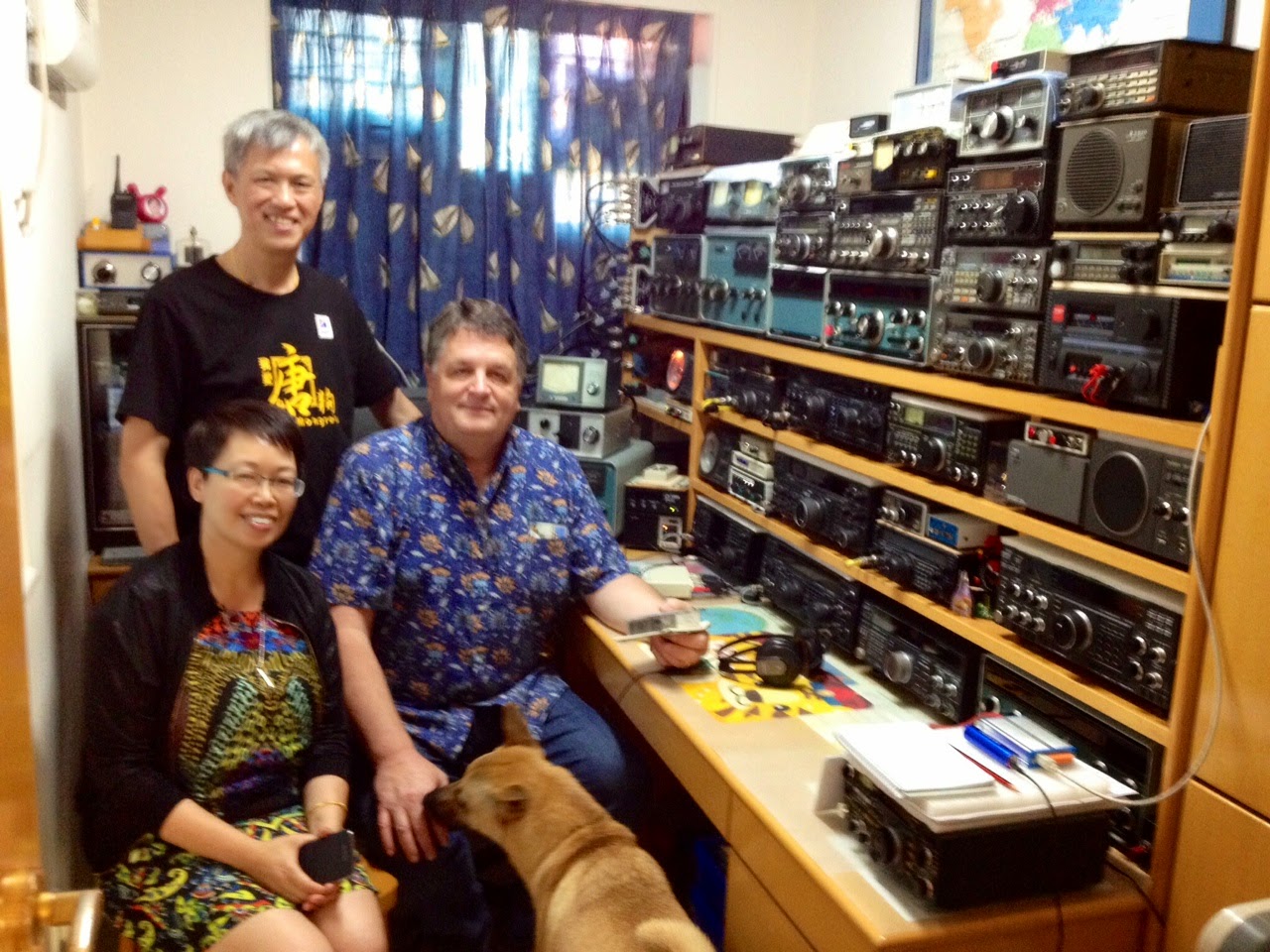
Pansy & Charlie Ho in their "ham shack" with Jeff and P.J. the dog
The Ho's live in a small village on the top floor of a three-story house with a nice roof veranda.  Their village is primarily residential with similar houses, surrounded by the mountains.

Jeff disappeared into Charlie's "ham shack" where the two of them tried out his setup, while I chatted with Pansy and got to know their dogs.  It was really nice to get some quality "dog time" after being dog-less for the three months we've been in Hong Kong. 
Charlie and Jeff on the roof inspecting antennae
Charlie has an elaborate ham shack with a bank of radios stacked on shelves against the wall and wiring that runs up to various antennae on the roof of their house.  We went up to their rooftop veranda to see their antenna setup.  A clear, sunny day meant that we were also able to take in their beautiful view of the surrounding mountains and, to the north, the border of mainland China and the skyscrapers in the city of Shenzhen.

The Ho's took us on a tour around Fanling to see some of the sites.  The Fanling-Sheung Shui area has grown quickly during the years that the Ho's have lived there, and its population is now around 300,000.  We visited an area known as Lung Yeuk Tau, which is comprised of five historic walled villages of the Tang Clan.  The Tang Clan originated in Jiangxi province in what is now mainland China, but are considered to be native Hong Kong people, having been the first to settle in what is now Hong Kong from China in the 11th century. 

Entrance to the Tung Kok Wai walled village

We visited the entrance towers of the To Wai and Tung Kok Wai walled villages.  Although hundreds of years old, people still live inside these villages.

We also visited the Tang Chung Ling Ancestral Hall.  An ancestral hall is a Chinese temple dedicated to deified ancestors of surname lineages of Chinese families.   Historically, ancestral halls were used for rituals or festivals in honor of a family's ancestors, including weddings and funerals.  In more recent times, the halls have also been used for community functions such as meetings and elections.  The Tang Chung Ling Ancestral Hall is the main ancestral hall of the Tang Clan and is one of the largest in Hong Kong.  It was built in the 16th century and consists of three buildings.


Pansy, Jeff and Charlie in front of Tang Chung Ling Ancestral Hall
After visiting Lung Yeuk Tau, we shared a traditional Chinese dinner at a lovely restaurant nearby.  We would like to thank Pansy, Charlie, Jade and P.J. for their hospitality and for hosting us to a wonderful and interesting day in the New Territories.
Jeff and Charlie sharing lobster, chicken and spicy beef at dinner

Sunday, April 13, 2014

The Big Buddha

Hong Kong is made up of more than 200 different islands.  Most of the population of more than 7 million lives on Hong Kong Island, the Kowloon Peninsula or in the New Territories.  But the largest of Hong Kong's islands is Lantau Island.  At just under 60 square miles, it is nearly twice the size of Hong Kong Island but Lantau's population is only about 100,000.
Lantau Island on the left; Hong Kong Island on the right
Other than the occasional trip to the airport, which is situated on Lantau Island, we haven't visited there, so with a warm and sunny Saturday on our hands, we decided to get away from the crowded city and do some exploring.  

View of Tung Chung from the cable car
Lantau Island is less than five miles west of Hong Kong Island, and there are a variety of ways to get there, including ferry, water taxi and on the Hong Kong subway system (the "MTR.")  We took the MTR across the harbor to Tung Chung, which is the most populated town on the island.  Lantau has a very mountainous and heavily forested terrain.  The island is even referred to as "the lungs of Hong Kong" because of its forests and relative lack of development.  There are trails for hikers, but we opted for a 3.5 mile cable car ride to Ngong Ping plateau.

Stilt Houses in Tai O

Development of the cable car system began in 2004 as part of a tourism project, and it has a colorful history involving everything from typhoon damage to trapped passengers to a criminal indictment of the operator's CEO.  But it has run smoothly for the past couple of years; we felt safe and enjoyed the amazing views during the half-hour journey. 

At the top of the gondola, we emerged into Ngong Ping village, a somewhat contrived cultural village positioned as the gateway to Tai O village, the Po Lin Monastery and the Tian Tan Buddha.

A dried seafood stand in Tai O

A short bus ride took us to Tai O, an old village on the west coast of Lantau centered on fishing and salt production.  The town became an entry point for illegals fleeing mainland China during the Chinese civil war (1927-1950).  Despite the difficulty of making a living on fishing, people there still live on the water in stilt houses and the town is crowded with dried seafood shops.  We wandered through the narrow streets and across the waterways linking them, dodging the locals eager to take us on a boat ride.


 After visiting Tai O, we took a short walk from Ngong Ping village up to the Tian Tan Buddha, one of five large Buddha statues in China.  It is made of bronze and, at 112 feet, was at one point the tallest seated Buddha statue in the world, having been overtaken by another statue in Jiangsu Province, China.  The path leading to the Tian Tan Buddha is flanked by statues of 12 "Divine Generals" that guard the statue.  Each symbolizes a different animal from the Chinese Zodiac and is armed with a different weapon. 
One of the 12 Divine Generals
There are 268 steps from the main walkway up to the Buddha, and there was no shortage of people making the climb.  Tian Tan Buddha was completed in late 1993.  Together with the nearby Po Lin Monastery, it is a major center for Buddhism in Hong Kong.

The Po Lin Monastery was founded in 1906.  The name means "precious lotus," and the lotus flower symbolizes purity in Buddhism.   The monastery is really a collection of elaborately carved buildings surrounded by beautiful and colorful grounds.  At the front, there is a courtyard with an area for offering incense, although a guide told us that worshipers are now encouraged to make offerings of flowers instead as an environmentally-friendly alternative to incense.  The first building is a smaller temple with statues of deities inside that act as guards which leads to a courtyard featuring the Great Hall or main temple building.  At the center of the lavish Great Hall are three golden Buddhas, each with a slightly different pose and facial expression representing the Buddha's past, present and future lives. 
The three golden Buddhas at Po Lin Monastery

The Great Hall at Po Lin Monastery

Our day trip to Lantau gave us a much-appreciated change of scenery from Central Hong Kong!

Saturday, April 5, 2014

Bula Fiji!


"Bula" means hello in Fijian.  Recently, we rekindled friendships with other SCUBA divers from Minnesota at a resort on Beqa (pronounced "Benga") Island in Fiji.   Since we've only just gotten settled in Hong Kong, we felt a little bit sheepish going off on vacation so soon, but we committed to this trip early last year and wanted to stick with the plan.

Fiji is truly an island nation, and Beqa is but one of Fiji’s 330 islands that are spread across both sides of the international date line.  Indeed, the country likes to boast that Fiji is "where the world begins each day."  Fijians are remarkably warm and hospitable people and the country is noted for its rugged and volcanic terrain, lush greenery, spectacular SCUBA diving and the occasional and relatively peaceful coup. 
 
Leaf Scorpion Fish
Testament to the vastness of the Pacific: Nadi (Fiji’s international airport) is 10 hours by air from Hong Kong, almost as long as the flight from LAX. Upon arrival we took a jitney 150 kilometers, followed by a 40-minute boat ride to our resort, where we stayed in a ‘bure’ (a glorified hut) for ten nights. The dining was as terrific as the diving, with menu options emphasizing fresh fruit and other south Pacific fare, supplemented by meat and dairy products from Australia and New Zealand.  Each day we marveled at the logistics required just to keep people fed.


SCUBA diving is the main activity at the resort, and I packed in 16 dives during our stay.  Because of its beautiful colors, soft coral is a real draw for SCUBA divers and it is more commonly found in the Pacific, along with a variety of critters unique to this region.  As usual, I shot a lot of photos. For anyone interested in seeing more of them, here is a video: (full disclosure: the video is 4-1/2 minutes long).

Blue Ribbon Eel
            
Jeff prefers amateur radio to diving. He obtained a Fijian license (3D2FJ) and made 1,028 2-way contacts on Morse Code with other amateurs in 62 countries and far-flung locations as remote as a Russian scientific base in the Antarctic, all on battery power. 
Jeff in his "Ham Shack"
On the remote islands, Fijians live in villages, and life there seems to revolve around the local schools.  During our stay on Beqa, we visited a primary school and a secondary school and were serenaded there (and on several other occasions) with songs sung in both English and Fijian.  Music is an integral part of Fijian life, and children are taught to sing from the time they start school, if not before.  Almost half of the students at the high school level are boarders due to the distances between villages and even other islands. We took a variety of school supplies that were gratefully accepted as donations.
The Beqa Secondary School serenades us
Our trip was a restful break from our busy lives here in Hong Kong and a wonderful opportunity to catch up with our friends from back home.  Vinaka (Fijian for "thank you") to Evie, Bill, Sue, Gary, Glenda, Tom, Bev and Denny for making our vacation so special!